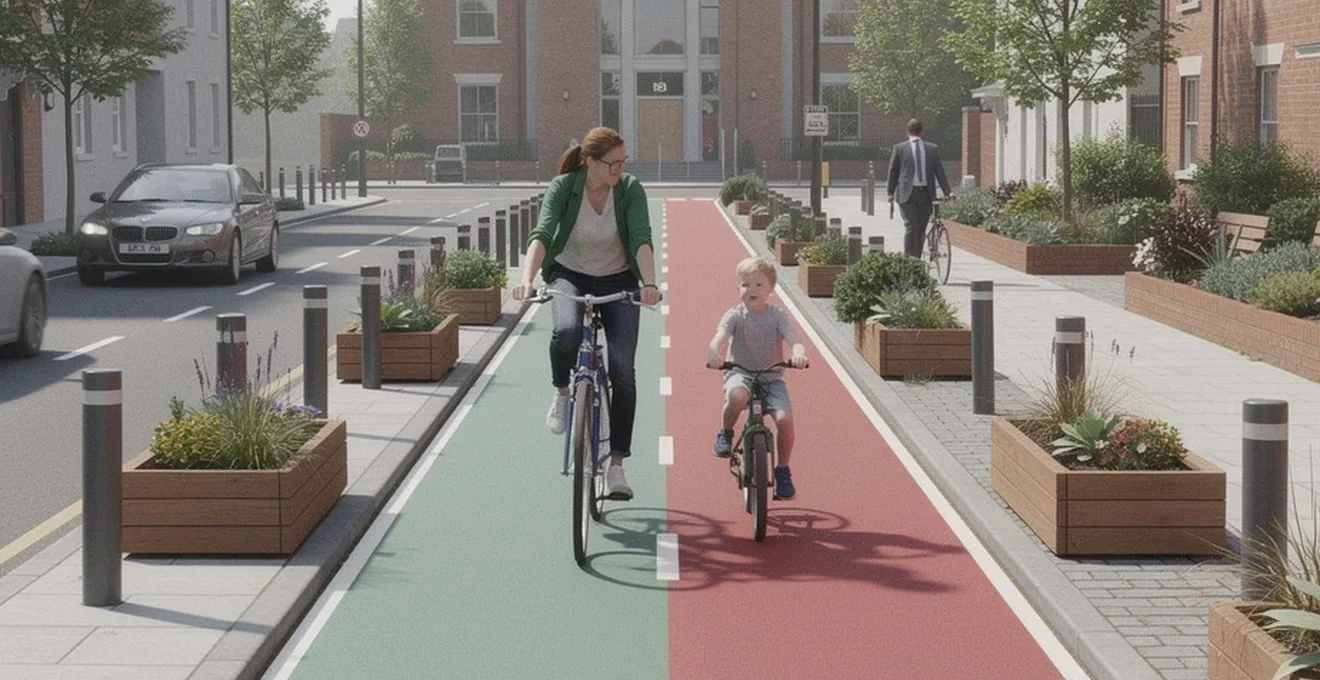
Cycling levels in the UK remain far below those of comparable European countries, with bicycles accounting for a fraction of daily journeys compared to the Netherlands, where 27% of all trips are made by bike. Local authorities hold much of the power to close this gap, but doing so requires more than painted lines on a road. It demands segregated cycle lanes, well-designed junctions, low traffic neighbourhoods, secure parking, and integration with public transport, all backed by sustained funding and clear national guidance. This article sets out the practical infrastructure measures councils can use to make cycling a safe, realistic choice for everyday journeys, drawing on established design standards, funding frameworks and behavioural interventions that have already shown results in UK towns and cities.
Segregated cycle lanes and protected infrastructure design
The single biggest barrier to cycling and walking in the UK is that streets and communities are not designed to make active travel feel safe and easy. Protected, physically separated cycle lanes address this directly by removing cyclists from the flow of motor traffic, rather than relying on paint alone to keep people safe.
Dutch CROW manual standards for cycle track width and segregation
The Netherlands is widely regarded as the benchmark for cycling infrastructure, and its approach is built on the principle that cycling routes must sit alongside, but physically separate from, roads. Dutch cycle superhighways typically have their own traffic light systems and are built wide enough to comfortably accommodate two-way flows and overtaking. The country currently has 25 such superhighways in use or under construction, and cycling infrastructure is treated as a core consideration whenever new transport infrastructure is planned, rather than an afterthought. Examples include dedicated cycle lanes built beneath the Driebergen-Zeist train station, demonstrating how segregation and integration with other transport modes are designed in from the outset.
London’s cycleway network and the TfL design standards
Within the UK, London has made the most visible progress towards Dutch-style segregation, part of a wider effort to prioritise walking and cycling over car use through investment in Dutch-style cycling infrastructure. Programmes such as the mini-Holland schemes rolled out across several London boroughs reflect this ambition, aiming for a radical transformation in urban mobility. Cycleways built to protected standards give riders continuous, physically separated space along key corridors, reducing conflict with motor vehicles at the points where collisions are most likely to occur.
Kerb-protected versus Armadillo-Style wand separation systems
Where full segregation isn’t immediately feasible, local authorities often use interim measures to physically separate cyclists from traffic. Kerb-protected lanes offer a more permanent, robust barrier, while lighter-touch options such as armadillo-style wands or planters provide a lower-cost way to establish separation quickly, which can later be upgraded. Both approaches respond to the same underlying evidence: infrastructure that only relies on road markings does little to reassure people who don’t already cycle regularly, and it is precisely those potential new cyclists that authorities need to attract.
Junction treatment using Dutch-Style roundabouts and protected intersections
Junctions remain among the most dangerous points for cyclists, and design here matters as much as the quality of the lanes themselves. The Hovenring in Eindhoven, a suspended cycling roundabout, was specifically designed to increase safety by separating cyclists from increasingly busy roads below. Protected intersection designs, which give cyclists their own signal phases and physical protection from turning vehicles, reflect the same logic and are increasingly referenced in UK design guidance as authorities look to reduce the collisions that occur most frequently where routes cross.
Low traffic neighbourhoods and modal filtering schemes
Alongside main road infrastructure, residential streets play a critical role in making cycling and walking the natural choice for short journeys. Low Traffic Neighbourhoods (LTNs) use modal filters to reduce through-traffic on residential roads while keeping them accessible to people walking and cycling. The Gear Change strategy, published by the UK government, has already resulted in the creation of at least 150 LTNs in addition to the thousands already in existence.
Waltham forest’s Mini-Holland programme as a case study
London’s mini-Holland schemes, including Waltham Forest’s programme, represent one of the most significant attempts to translate Dutch-style street design into a UK residential context. These schemes combine filtered permeability, protected cycle routes and public realm improvements, aiming to make walking and cycling the default option for short trips rather than the exception.
Bollard and Planter-Based modal filters for Rat-Running prevention
Modal filters, whether bollards, planters or camera-enforced restrictions, work by blocking through-traffic for motor vehicles while allowing cyclists and pedestrians to pass freely. This prevents rat-running on residential streets and reduces both traffic volume and speed, addressing one of the most commonly cited reasons people avoid cycling: fear of sharing the road with fast-moving or high volumes of motor traffic.
School streets initiatives and timed vehicle restrictions
School Streets schemes apply similar principles at specific times of day, restricting motor vehicle access around school gates during drop-off and pick-up periods. This directly supports the government’s ambition for 60% of English children to walk or cycle to school by 2035, a target that stood at just 47% as of 2023. By removing traffic congestion and danger at the point where it is most concentrated, these timed restrictions make active travel to school a more realistic option for families.
Cycle parking and End-of-Trip facility provision
Safe, convenient parking is a precondition for cycling uptake, particularly for utility journeys such as commuting or shopping. Without confidence that a bike can be left securely, many potential cyclists simply won’t make the switch from other modes.
Sheffield stand deployment in town centre retail zones
Sheffield stands, the inverted-U style racks common across the UK, remain one of the most practical and cost-effective solutions for short-stay cycle parking in retail and town centre locations. Their wide deployment supports the case that better infrastructure brings customers back to the high street, addressing concerns from local businesses that cycling infrastructure might reduce footfall or accessibility.
Secure cycle hub models such as leeds station cycle point
For longer-stay or higher-value parking needs, particularly at transport hubs, secure cycle hubs offer monitored, sheltered storage. These facilities are especially important for commuters combining cycling with rail travel, giving them confidence that their bike will remain safe throughout the working day.
Bike hangar schemes for On-Street residential parking
In areas with limited off-street storage, particularly terraced housing and flats, on-street bike hangars provide secure, lockable parking for several bicycles within the footprint of a single car parking space. This addresses a specific barrier facing residents without gardens, sheds or hallways large enough to store a bike, which can otherwise make cycling impractical regardless of how good the on-road infrastructure is.
Integrating cycling with public transport networks
Cycling rarely operates in isolation from other modes of transport. Effective integration between cycling and public transport extends the practical range of both, allowing people to cycle to a station and complete a longer journey by train, or vice versa.
Bike-and-ride provision at rail stations including cambridge north
Stations with generous, secure cycle parking allow commuters to combine active travel with rail journeys, widening the catchment area of the station without requiring additional car parking. This mirrors practice seen in the Netherlands, where cycling infrastructure is built directly into station design, such as the dedicated cycle lanes constructed below Driebergen-Zeist station.
Cycle carriage policies on regional rail franchises
Policies allowing bikes to be carried on trains, particularly outside peak hours, support longer multi-modal journeys and give cyclists flexibility when weather, fatigue or distance make a full journey by bike impractical. Consistent, clearly communicated cycle carriage rules across regional franchises reduce uncertainty for passengers planning to travel with a bicycle.
Funding mechanisms and policy frameworks for active travel
None of these interventions are possible without sustained funding and a clear policy framework. The UK government has committed £2 billion over five years for cycling and walking, with £338 million invested in England during 2021/22 alone. More recently, the third cycling and walking investment strategy (CWIS3) has put forward a £4.5 billion investment package aimed at delivering around 5,000 walking, wheeling and cycling routes by 2030, alongside 10,000 safer crossings.
Active travel fund allocation and local transport plans
Funding allocated through active travel programmes is typically channelled to local authorities via local transport plans, allowing councils to prioritise schemes according to local need. Active Travel England, launched in 2022, oversees this process, with its main objective being to create schemes that enable more people to walk, wheel and cycle safely. As part of its strategy, it will provide £135 million to support schools and community programmes, helping schools develop travel plans and supporting people to start cycling or riding again.
Gear change strategy and department for transport LTN 1/20 guidance
The Gear Change strategy, published in 2020, set out the government’s spending plan and led directly to the creation of new Low Traffic Neighbourhoods and more than 100 miles of new cycle lanes on main roads. Sitting alongside this is the Department for Transport’s Local Transport Note LTN 1/20, which provides detailed technical guidance to local authorities on delivering high-quality, safe cycling infrastructure. This covers planning for cycling, space for cycling within highways, transitions between carriageways and cycle tracks, junctions and crossings, cycle parking, traffic signs and road markings, and construction and maintenance standards. LTN 1/20 replaced earlier guidance documents, Shared use routes for pedestrians and cyclists (LTN 1/12) and Cycle infrastructure design (LTN 2/08), consolidating design standards into a single, more rigorous framework that authorities are expected to follow when designing new schemes.
Section 106 contributions and Developer-Funded cycling infrastructure
New housing and commercial developments represent another funding route, with developer contributions used to fund cycling infrastructure as part of the wider planning process. This is particularly important given criticism that most new developments are designed for car dependency, preventing homeowners from experiencing the mental and physical health benefits that come from active travel. Requiring developers to fund cycle routes, parking and safe crossings as a condition of planning permission helps ensure new communities are not built with the same car-dependent patterns as those that came before.
Behavioural interventions and cycling uptake measurement
Infrastructure alone does not guarantee uptake. Behavioural interventions, and the data used to plan and measure them, are essential complements to physical investment.
Bikeability training programmes in primary and secondary schools
Practical cycle training helps build the confidence and skills needed to cycle safely on real roads, particularly for children and young people who are least likely to have developed these skills independently. Training programmes delivered in schools support the government’s ambition to increase the proportion of children walking or cycling to school, working alongside infrastructure measures such as School Streets rather than as a substitute for them.
Propensity to cycle tool for route prioritisation modelling
Modelling tools that estimate where cycling demand is likely to be highest allow local authorities to prioritise investment where it will have the greatest impact, rather than spreading limited funding thinly across a network. This kind of evidence-based prioritisation responds directly to a problem identified by transport planners: low cycling numbers can create a self-reinforcing view that there is no demand for infrastructure, when in fact the absence of safe routes is suppressing demand in the first place.
Automatic cycle counters and DfT traffic count methodology
Ongoing monitoring is essential to understand whether interventions are working. Automatic cycle counters, combined with the Department for Transport’s traffic count methodology, provide the data needed to track changes in cycling levels over time. This matters given recent trends: cycling in Britain doubled in 2020, reaching 1.8% of all traffic mileage compared with 0.9% between 2015 and 2019, before falling back by 27% in 2021. Reliable, consistent monitoring allows authorities to understand whether specific schemes are contributing to a lasting shift in travel behaviour, or whether gains made during periods such as the pandemic are being lost as conditions change. This evidence, in turn, supports the case for continued investment and helps refine future scheme design based on what has actually worked on the ground.