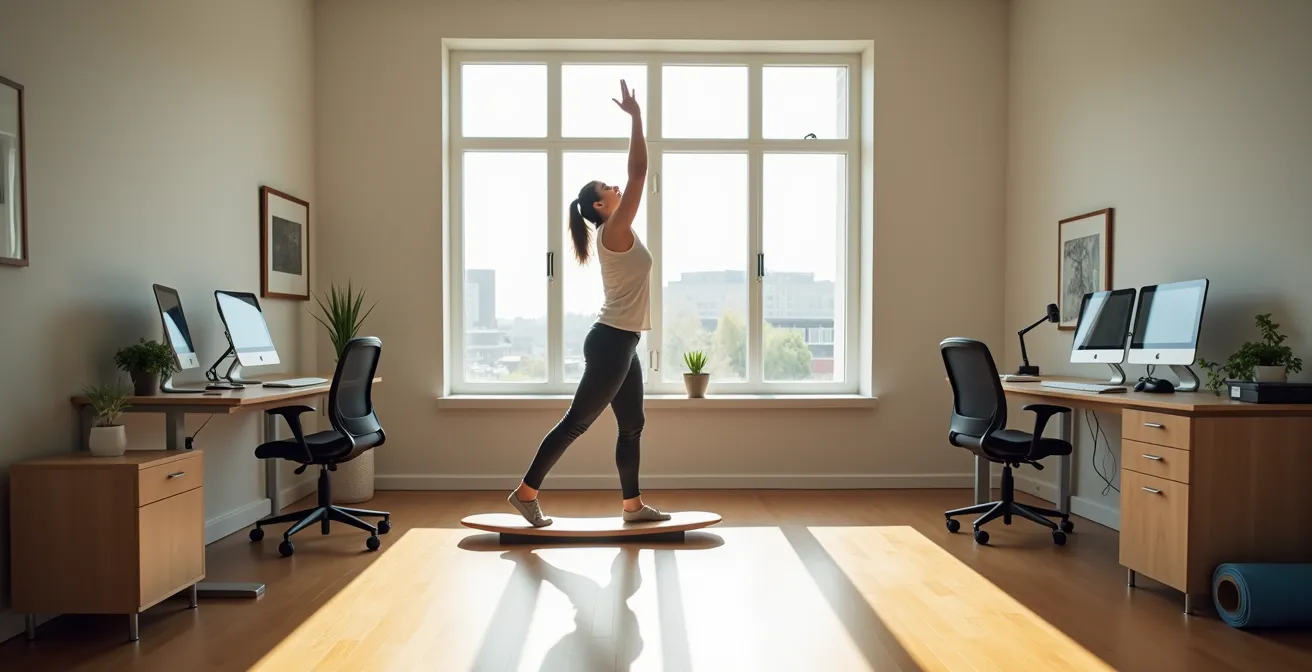
The belief that an hour at the gym can erase a full day of sitting is a dangerous myth that ignores your body’s basic physiology.
- Prolonged sitting deactivates key fat-burning enzymes in your muscles, a process that sporadic, intense exercise can’t fully reverse.
- The true solution is ‘NEAT’ (Non-Exercise Activity Thermogenesis) — the energy you burn from small, consistent movements throughout your entire day.
Recommendation: Focus on re-engineering your environment and daily routines to make constant, low-intensity movement an automatic and effortless part of your life.
For many office workers, the daily routine is a familiar story: a full day spent in a chair, followed by a frantic attempt to “undo” the damage with an intense hour at the gym. We diligently track our workouts, believing that this concentrated effort is the key to staying healthy and managing our weight. Yet, we often feel sluggish, see minimal results, and wonder why our dedication doesn’t seem to pay off. The common advice to “take the stairs” or “park further away” feels like a drop in the ocean against a tidal wave of sedentary behavior.
But what if the entire premise is flawed? What if the most powerful tool for burning calories isn’t found in a gym, but in the small, almost unnoticeable movements we make—or fail to make—throughout the day? The problem isn’t a lack of exercise; it’s an abundance of stillness. This is where the science of NEAT, or Non-Exercise Activity Thermogenesis, changes the game. NEAT is the energy expended for everything we do that is not sleeping, eating, or sports-like exercise. It’s the gentle hum of your body’s metabolic engine, and for most of us, that engine is idling far too low.
This guide will shift your focus from isolated “workouts” to integrated “movement snacks.” We will explore the science that explains why constant, low-level activity is more powerful than a single burst of exercise for your metabolism. You will learn how to transform your workspace into an active environment, master the art of “stealth” stretching during video calls, and redesign your home to make healthy habits the default choice. The goal is to burn those extra 300 calories not by adding another task to your to-do list, but by weaving movement invisibly into the fabric of your life.
To help you navigate this new approach, this article breaks down the core principles and actionable strategies you can implement immediately. From understanding the biology of sitting to redesigning your environment, each section builds on the last to provide a comprehensive roadmap.
Summary: Reclaiming Your Metabolism Without the Gym
- Why 1 Hour of Gym Doesn’t Undo the Damage of Sitting for 8 Hours?
- How to Build a Stretching Routine You Can Do During Zoom Meetings?
- Walking Pad vs Standing Desk: Which Is better for Deep Work Focus?
- The “Weekend Warrior” Mistake That Leads to ACL Tears in Your 40s
- How Often Should You Move to Keep Lipoprotein Lipase Active?
- How to Integrate Video Tools to Reduce “Zoom Fatigue” by 50%?
- Silent Observation vs Adrenaline Sports: Which Recharges the Brain More Effectively?
- How to Design Your Home Environment So That Healthy Habits Become Automatic?
Why 1 Hour of Gym Doesn’t Undo the Damage of Sitting for 8 Hours?
The concept of “making up for” a day of sitting with a single workout is deeply ingrained in our fitness culture, but it’s fundamentally at odds with how our bodies are designed. The critical issue isn’t just the calories you burn during exercise; it’s what happens to your metabolism during long periods of inactivity. When you sit for extended durations, you effectively switch off key metabolic processes at a cellular level. The most significant of these involves an enzyme called lipoprotein lipase (LPL), which plays a crucial role in breaking down fats in the blood to be used as energy by your muscles.
When your muscles, particularly the large ones in your legs and glutes, are inactive, LPL activity plummets. In fact, compelling research shows that physical inactivity can suppress muscle LPL activity by as much as 90-95%. This means your body’s ability to process fats and sugars from your bloodstream is severely impaired. That one-hour gym session, while beneficial for cardiovascular health and muscle strength, is simply too brief to counteract the cumulative metabolic damage from the other 8, 10, or 12 hours of sitting. It’s like trying to bail out a constantly flooding boat with a small bucket once a day.
This enzymatic shutdown is the biological reason why even active individuals who have sedentary jobs can face an increased risk of metabolic syndrome, weight gain, and cardiovascular issues. The solution, therefore, isn’t necessarily more intense exercise, but more consistent, low-level movement. The goal is to prevent your body from ever entering that metabolic “sleep mode” in the first place by regularly activating your muscles throughout the day.
How to Build a Stretching Routine You Can Do During Zoom Meetings?
One of the biggest obstacles to moving more during the workday is the perception of unprofessionalism, especially with the rise of video calls. The good news is that you can build an effective stretching routine that is virtually invisible to your colleagues. The key is to focus on “stealth stretches”—small, controlled movements that relieve tension without drawing attention. These subtle actions keep your muscles engaged and blood flowing, combating the stiffness that comes from being locked in a single position.
Think about movements that happen below the desk or out of the camera’s frame. You can perform ankle rotations, point and flex your feet to stretch your calves, or do seated leg raises to activate your quads. For your upper body, focus on posture. Squeeze your shoulder blades together for a few seconds to open up your chest, gently tuck your chin to stretch the back of your neck, or perform seated cat-cow stretches by arching and rounding your lower back. These movements are quiet, subtle, and incredibly effective.
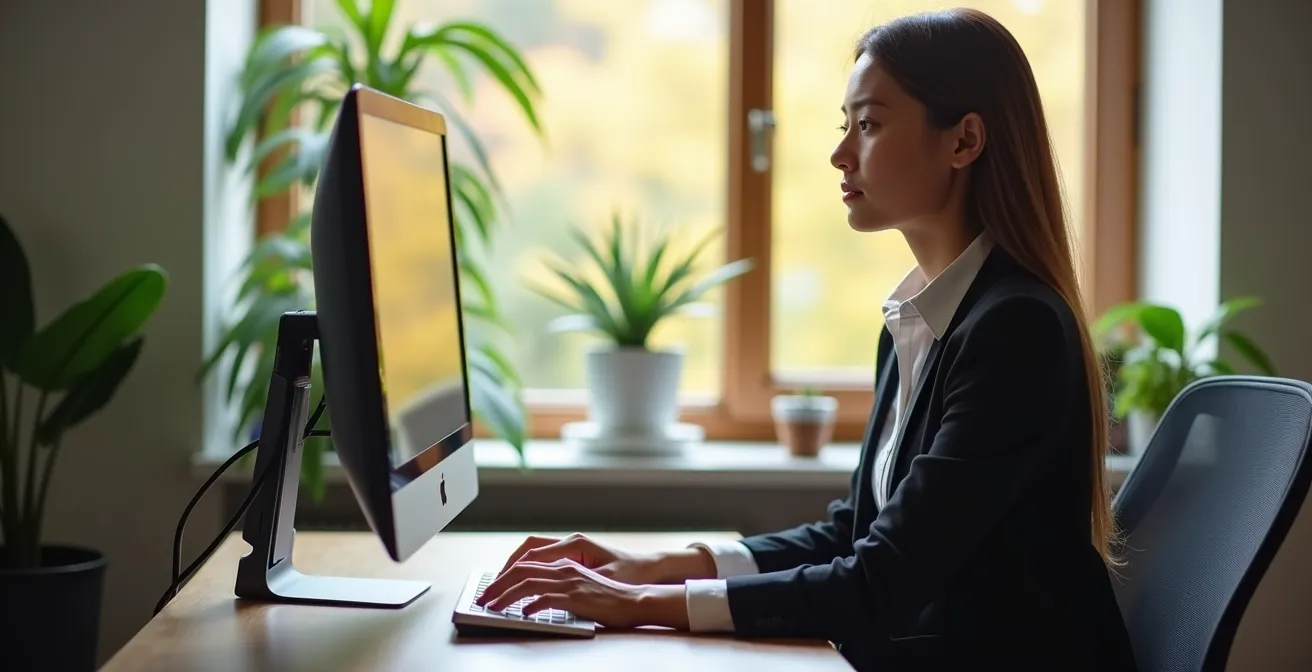
As this demonstrates, the focus is on maintaining professional posture while integrating micro-movements. You can also use the moments when your camera is off or during audio-only meetings to stand up for a more significant stretch. Integrating these “movement snacks” helps maintain cognitive function and prevents the physical strain of prolonged sitting. Studies show that these simple exercises during sedentary work can burn a significant number of extra calories per hour, contributing directly to your daily NEAT.
Walking Pad vs Standing Desk: Which Is better for Deep Work Focus?
As awareness of sedentary risks grows, standing desks and under-desk walking pads have become popular solutions. But they are not interchangeable; each serves a different purpose and has a distinct impact on focus and productivity. Choosing the right tool depends entirely on the nature of the task at hand. A standing desk is a static solution that primarily combats the negative effects of sitting, while a walking pad introduces continuous, low-intensity movement.
The fundamental trade-off is between creative thinking and precision-focused work. Movement, even at a slow pace, has been shown to boost creativity and divergent thinking, making a walking pad ideal for brainstorming sessions, listening to presentations, or engaging in collaborative calls. The gentle physical activity stimulates blood flow to the brain, helping you make novel connections. However, that same movement can be a detriment when your task requires intense concentration and fine motor skills, such as coding, detailed editing, or complex data entry. For these tasks, a standing desk is superior. It keeps your body active and engaged without creating the physical “noise” that can disrupt deep work.
To help clarify the best use for each, a comparative analysis based on typical outcomes can be a useful guide. The following table breaks down the key differences:
| Feature | Walking Pad | Standing Desk |
|---|---|---|
| Best For | Creative tasks, brainstorming | Precision work, coding |
| Calories Burned/Hour | 180-250 | 130-186 |
| Cognitive Impact | Boosts divergent thinking | Maintains focused attention |
| Movement Type | Continuous low-intensity | Static with micro-adjustments |
Ultimately, the ideal setup may be a hybrid one: using a walking pad for parts of the day dedicated to creative or less-intensive tasks, and switching to a simple standing or sitting position for periods requiring deep, uninterrupted focus. The goal is to match the tool to the task for optimal health and productivity.
The “Weekend Warrior” Mistake That Leads to ACL Tears in Your 40s
The “weekend warrior” phenomenon is a classic example of good intentions leading to bad outcomes. After a week of relative inactivity at a desk, the temptation is to cram a week’s worth of physical activity into two days. Whether it’s a high-intensity sport, a long run, or heavy yard work, this sudden shift from sedentary to explosive activity puts immense strain on a body that is simply not prepared for it. This pattern is a leading cause of non-contact injuries, particularly ACL tears and other ligament sprains, especially for individuals in their 30s and 40s.
The underlying problem is a loss of tissue readiness. During periods of prolonged sitting, your muscles, tendons, and ligaments lose some of their elasticity and responsiveness. They become “cold” and less able to absorb sudden impacts or adapt to quick changes in direction. As neuroscientist Dr. Andrew Huberman explains, the disconnect between our weekday and weekend activity levels is a recipe for disaster.
Sedentary weekdays lead to a decrease in tendon and ligament elasticity and muscle readiness. The sudden, high-impact weekend activity then overloads these unprepared connective tissues.
– Dr. Andrew Huberman, Neuroscientist perspective on movement and injury prevention
This overload is precisely what causes injury. Your brain may remember how to perform the movement, but the connective tissues lack the conditioning to execute it safely. Integrating NEAT throughout the week is not just about burning calories; it’s a crucial injury prevention strategy. By keeping your muscles and connective tissues consistently engaged with light activity, you maintain their readiness and resilience. This ensures that when you do engage in more intense weekend activities, your body is prepared to handle the load, drastically reducing your risk of injury.
How Often Should You Move to Keep Lipoprotein Lipase Active?
To counteract the metabolic slowdown from sitting, the key is frequency. The scientific consensus suggests that you should aim to break up periods of sitting at least every 30 to 45 minutes. This doesn’t require a full-blown workout; even one to two minutes of light activity is enough to “wake up” your muscles and reactivate the critical lipoprotein lipase (LPL) enzymes. The goal is to send a consistent signal to your body that it needs to stay metabolically alert. Think of these as “movement snacks”—small, frequent, and easy to digest.
These movements can be as simple as standing up to stretch, walking to the kitchen for a glass of water, or doing a few air squats by your desk. Even fidgeting—bouncing a leg, tapping your feet, or shifting your posture—contributes significantly to your daily energy expenditure. In fact, some research from Harvard Medical School found that non-exercise movement can burn up to an additional 350 calories per day for some individuals. This is the power of NEAT in action. The cumulative effect of these tiny movements is massive.
To make this a consistent habit, it’s helpful to have a menu of options categorized by intensity and convenience. This allows you to choose a movement that fits the moment, whether you’re on a call or have a few minutes between tasks.
- Level 1 (At Your Desk): Seated calf raises, glute squeezes while sitting, leg bouncing, shoulder rolls.
- Level 2 (60-Second Break): A quick walk to another room, 10 air squats, or a brief wall sit.
- Level 3 (High-Intensity Burst): If you have privacy and a few minutes, 20 jumping jacks or a quick sprint up a flight of stairs can provide a powerful metabolic boost.
Setting a recurring timer on your watch or computer is a powerful strategy to build this habit. Don’t wait until you feel stiff; be proactive. By regularly interrupting your sitting time, you keep your LPL enzymes active and your metabolic engine humming all day long.
How to Integrate Video Tools to Reduce “Zoom Fatigue” by 50%?
The term “Zoom fatigue” isn’t just about being in too many meetings; it’s about the intense cognitive load of being constantly “on.” When you’re on camera, you’re subconsciously monitoring your own facial expressions, background, and posture, which forces you into a state of unnatural stillness. This rigidity is a major contributor to both mental and physical exhaustion, and it completely stifles your NEAT. The solution lies in consciously changing team culture around video tool usage.
The most effective strategy is to implement a “cameras optional” or “camera-break” culture, particularly during long meetings. This doesn’t mean abolishing video entirely, but using it strategically. For instance, teams can agree to have cameras on for the first five minutes for greetings and introductions, then switch to audio-only for the bulk of the discussion, and turn them back on for final decisions or wrap-ups. This simple change liberates participants to stand up, stretch, walk around their room, or even use a walking pad while remaining fully engaged through audio.
Case Study: The Impact of “Cameras Optional” Culture
A growing number of companies are experimenting with new video meeting norms to combat fatigue. In one common implementation, teams establish clear guidelines where cameras are mandatory for brief check-ins and key decision-making moments but are explicitly optional during longer presentations or general discussions. Internal surveys at companies that have adopted this model report a reduction in self-reported meeting fatigue by up to 50%. This approach allows participants to move freely, reducing physical stagnation and freeing up cognitive resources that were previously spent on self-monitoring, all while maintaining active audio participation and engagement.
By advocating for these small changes, you not only reduce your own fatigue but also encourage a healthier, more movement-friendly culture for your entire team. It reframes the purpose of a meeting from a static, visual performance to an active, collaborative session. This shift allows NEAT to become a natural part of the workday, rather than something that has to happen “in between” calls.
Silent Observation vs Adrenaline Sports: Which Recharges the Brain More Effectively?
When we think about “recharging” after a long week of work, our minds often jump to two extremes: the complete stillness of a relaxing weekend or the high-octane rush of an adrenaline sport. However, for a body and mind fatigued by sedentary work, the most effective form of recharge may lie in a third category: restorative movement. This involves gentle, mindful activities that engage the body without over-stressing it, such as a slow walk in nature, yoga, or tai chi.
Adrenaline sports, like mountain biking or competitive games, provide a powerful dopamine rush that can feel invigorating after monotonous tasks. However, this can also be depleting and may not be sustainable as a daily or weekly practice, especially if it feeds into the “weekend warrior” cycle. On the other end of the spectrum, purely silent observation, like watching a movie, can be relaxing but does little to counteract the physical effects of a sedentary week. It keeps the body in the same passive state it was in all week.
Restorative movement offers the best of both worlds. It activates the brain’s Default Mode Network—the part associated with creative thought and self-reflection—similarly to silent observation, but it does so while engaging the body. This gentle activity promotes a sustainable release of endorphins and reduces cortisol levels without the risk of overexertion or injury. It calms the nervous system while simultaneously contributing to your overall NEAT, making it a perfect antidote to a week spent at a desk. It recharges both the mind and the body in a balanced, holistic way.
Key Takeaways
- The core problem is not a lack of exercise, but an abundance of stillness that deactivates key metabolic enzymes (LPL).
- NEAT (Non-Exercise Activity Thermogenesis) is the solution—integrating small, consistent “movement snacks” throughout the day to keep your metabolism active.
- Environmental design is more powerful than willpower; making movement easy and sitting harder is the key to long-term success.
How to Design Your Home Environment So That Healthy Habits Become Automatic?
Willpower is a finite resource. Relying on it to force yourself to move more is a losing battle. A far more effective strategy is to design your environment so that movement becomes the path of least resistance. This concept, often discussed in habit formation literature, is about increasing the “friction” for sedentary behaviors and decreasing it for active ones. By making small, strategic changes to your home and office setup, you can nudge yourself toward healthier habits automatically.
Start by identifying the friction points for movement. Is your yoga mat rolled up in a closet? Leave it permanently unrolled in a corner of your living room or office. This visual cue serves as a constant invitation to stretch. Do you have a pull-up bar hidden away? Install it in a doorway you walk through frequently. Every time you pass it, you’ll be reminded to do a quick hang or a pull-up. These are called “activity zones”—pairing specific locations in your home with a specific movement.
Conversely, add friction to your sedentary habits. Instead of keeping the TV remote on the coffee table, place it in a drawer in another room. The simple act of having to get up to grab it might be enough to make you reconsider turning on the TV. Use a kettlebell or a dumbbell as a doorstop; its presence is a powerful visual trigger. The secret to success, as many experts note, is this focus on unconscious cues.
The secret? NEAT, or Non-Exercise Activity Thermogenesis — the calories you burn from everyday movement. Boosting your NEAT can help you burn hundreds of extra calories each day, without ‘working out.’
– Merit Weight Loss Research Team, 30 Easy Ways to Burn More Calories Without the Gym
By thoughtfully curating your environment, you offload the mental effort of “deciding” to move. The healthy choice becomes the easy choice, allowing you to boost your NEAT and burn more calories effortlessly.
Your 5-Point Home Environment Audit for Automatic Movement
- Map Your Paths: Trace your most common daily routes through your home (e.g., from desk to kitchen). Identify one spot on each path where you can place a “movement trigger” (e.g., a foam roller by the sofa).
- Increase Sedentary Friction: List your top 3 sedentary temptations (TV, couch, social media on your phone). For each, add one small barrier, like placing the TV remote in another room or moving charging stations away from your relaxation spots.
- Decrease Movement Friction: Identify one piece of exercise equipment you own but rarely use. Move it to a permanent, visible location where it becomes part of the decor (e.g., yoga mat unrolled, kettlebell as a doorstop).
- Audit Your Workstation: Evaluate your desk setup. Is there space to stand? Is your chair so comfortable you never want to leave it? Consider replacing it with an active sitting stool or setting a timer to force breaks.
- Create a “Movement Menu”: Post a list of 5-minute activities (stretching, walking, squats) on your fridge or monitor. When you find yourself with a spare moment, you don’t have to think—just choose an item from the menu.
Start today by choosing just one change from the audit above. The journey to a more active life begins not with a gym membership, but with a single, intentional step to make movement an effortless part of your world.