Effective circadian lighting is not about buying color-changing bulbs; it’s about designing an integrated physiological support system.
- The system’s reliability (Wi-Fi vs. Zigbee) is more critical than the brand of the bulb for consistent biological signaling.
- Invisible factors like LED flicker and poor sensor logic can actively sabotage your health, negating the benefits of color temperature changes.
- A true solution synchronizes light’s color, intensity, and timing with your body’s internal clock, from a simulated dawn to a digital sunset.
Recommendation: Prioritize building a robust, flicker-free Zigbee mesh network as the foundation before investing in any specific lighting fixtures.
In our modern lives, we spend over 90% of our time indoors, disconnected from the sun’s natural rhythm. This profound lack of dynamic light exposure disrupts our core biological clock, the circadian rhythm, leading to morning grogginess, afternoon slumps, and poor sleep. The common solution—installing a few smart bulbs and setting them to “warm” at night—is a well-intentioned but fundamentally incomplete approach. It’s like trying to conduct a symphony with only a flute. This addresses only one small part of a complex biological system.
The conventional wisdom focuses on color temperature, but it often ignores the technical pillars that make a lighting system truly effective. Issues like network reliability, the invisible stress of LED flicker, and clumsy automation logic can undermine any potential benefits. But what if the real key to mastering your environment wasn’t just changing a light’s color, but engineering a complete, automated ecosystem? What if you could design your home’s lighting to act as a precise instrument, delivering the right spectral “dose” at the right time to actively support your physiology?
This guide moves beyond the simplistic advice. We will explore the science of light’s impact on your hormones, the technical decisions crucial for a reliable system, and the practical steps to program a lighting environment that provides energizing mornings and primes your body for deep, restorative sleep. It’s time to stop just illuminating rooms and start orchestrating your biology.
text
To navigate this technical deep dive, this article is structured to build your expertise from the foundational science to the final, integrated system. The following summary outlines each critical component we will cover.
Summary: The Complete Guide to Engineering Your Circadian Lighting System
- Why Does 6000K Blue Light Suppress Melatonin More Than Caffeine?
- How to Program a Sunrise Simulation That Wakes You Up Without an Alarm?
- Wi-Fi Bulbs vs Zigbee Hub: Which System Is More Reliable for Whole-Home Lighting?
- The Invisible “LED Flicker” That Causes Migraines and Eye Strain
- Where to Place Motion Sensors to Avoid Lights Turning Off While You Read?
- How to Time Your Morning Walk to Reset Your Circadian Rhythm in 20 Minutes?
- In what order should you perform evening rituals to prime sleep?
- How to Synchronize IoT Devices to Automate Your Entire Morning Routine?
Why Does 6000K Blue Light Suppress Melatonin More Than Caffeine?
The powerful effect of light on our wakefulness cycle goes far beyond simple brightness. The core mechanism lies in specialized cells in our retinas called intrinsically photosensitive retinal ganglion cells (ipRGCs). These cells contain a photopigment called melanopsin, which is most sensitive to light in the blue-to-cyan portion of the spectrum, peaking around 480nm. When this specific wavelength hits the retina, melanopsin signals directly to the suprachiasmatic nucleus (SCN)—the body’s master clock.
This signal is interpreted as “daytime” and triggers a cascade of hormonal responses. Most notably, it forcefully suppresses the production of melatonin, the hormone of darkness that prepares the body for sleep. The effect is dose-dependent; brighter, bluer light causes a more significant and rapid shutdown of melatonin production. In fact, specific research from the Journal of Applied Physiology demonstrates that blue-spectrum light has a potent, direct, and quantifiable suppressive effect on melatonin levels.
Unlike caffeine, which works by blocking adenosine receptors to create a temporary feeling of alertness, blue light intervenes at a much more fundamental level. It directly manipulates the master hormonal switch that governs the entire sleep-wake cycle. This is why exposure to a 6000K (cool, blue-rich) light source in the evening can delay sleep onset far more effectively than a late-afternoon coffee. You aren’t just masking fatigue; you are actively telling your brain’s master clock that it is still midday.
Understanding this potent biological trigger is the first step in designing a lighting system that works with, not against, your physiology.
How to Program a Sunrise Simulation That Wakes You Up Without an Alarm?
A blaring alarm clock is a stressful, cortisol-spiking way to start the day. A far more natural and effective method is to use light to gently guide your body out of sleep. A “sunrise simulation” replicates the gradual increase in light intensity and color temperature of a natural dawn, signaling to your body that it’s time to wake up. This process slowly reduces melatonin and begins the morning cortisol pulse, so you feel awake and alert *before* your target wake-up time, rather than being jolted into it.
To program an effective sunrise simulation, precision is key. The sequence should begin 30 to 45 minutes before your desired wake-up time. It starts not with white light, but with a very dim, deep red hue (around 1900K). This low-intensity warm light begins to inhibit melatonin without being disruptive. Over the next half-hour, the automation should smoothly transition the light through orange and warm white (2700K) to a bright, blue-enriched daylight color (5000K-6000K) at 100% brightness, peaking precisely at your target wake time.
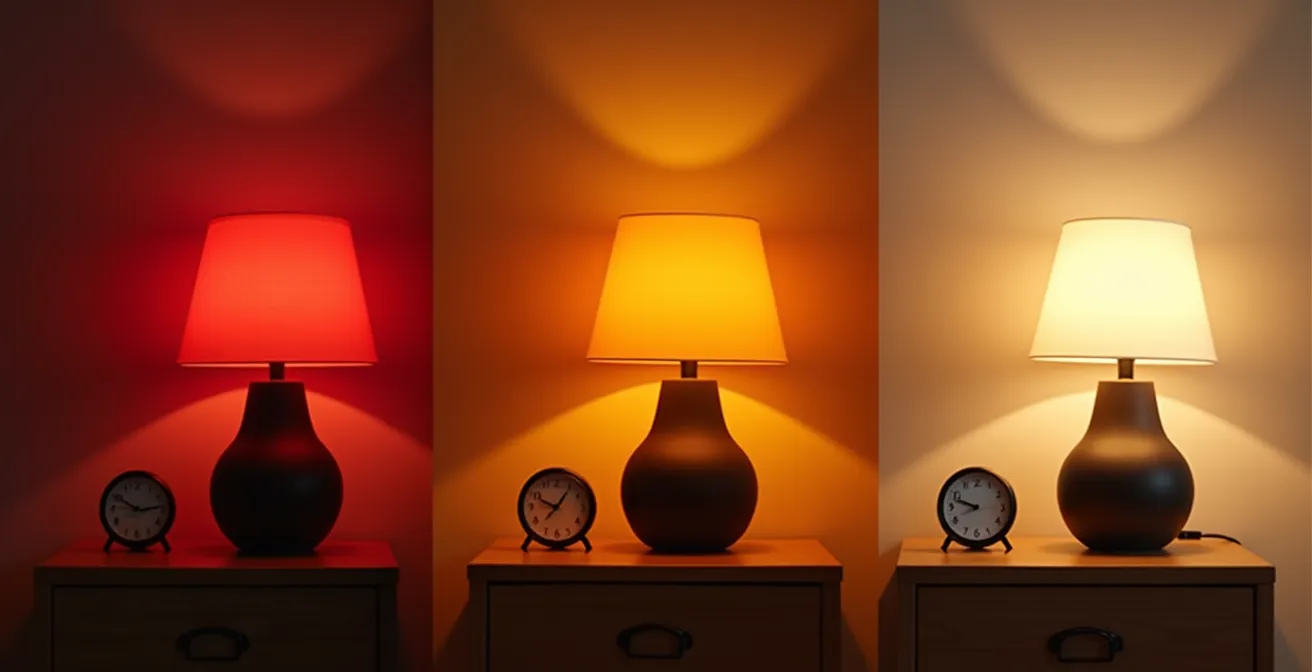
As this visual progression shows, the goal is to create a seamless shift in both intensity and color spectrum. Many smart lighting apps (like Philips Hue, or home automation platforms like Home Assistant) allow you to create these “fade-in” scenes. The key is to ensure the transition is slow and steady, mimicking nature’s pace. This gentle ramp-up prepares your brain for wakefulness, often allowing you to wake up naturally and feeling refreshed, just as the light reaches its peak, making the audible alarm clock entirely redundant.
By replacing the auditory shock of an alarm with the biological signal of a sunrise, you fundamentally change the tone of your entire morning.
Wi-Fi Bulbs vs Zigbee Hub: Which System Is More Reliable for Whole-Home Lighting?
When building a circadian lighting system, the choice of wireless technology is a foundational decision that dictates reliability and performance. While individual Wi-Fi bulbs are inexpensive and easy to set up, they are a poor choice for a whole-home system. Each Wi-Fi bulb connects directly to your home router, creating a separate connection. As you add more devices—bulbs, switches, sensors—you can quickly overwhelm your router’s capacity, leading to slow response times, dropped connections, and unreliable automation.
A far more robust solution is a system based on a dedicated hub that uses protocols like Zigbee or Z-Wave. In this model, only the hub connects to your router. The bulbs and devices themselves create a separate, independent “mesh network.” Each device in a mesh network acts as a repeater, strengthening and extending the network’s reach and reliability as you add more devices. This architecture is vastly more scalable and is not dependent on your home’s Wi-Fi traffic.
Furthermore, Zigbee systems offer near-instantaneous local control. When you trigger a scene, the command is sent from the hub directly to the devices over the mesh network, without having to travel to a cloud server and back. This eliminates the noticeable lag common with cloud-dependent Wi-Fi systems. This is particularly critical for synchronized scenes, like a whole-room color change, which happens instantly on Zigbee but can appear as a “popcorn effect” on overloaded Wi-Fi.
This comparative analysis highlights the critical differences in performance for anyone serious about home automation. As shown in a recent IoT technology overview, the underlying network is key.
| Feature | Wi-Fi Bulbs | Zigbee Hub System |
|---|---|---|
| Network Load | Can strain router with 30-50 devices | Separate mesh network, hundreds of devices |
| Response Time | Cloud-dependent, noticeable delay | Local control, instantaneous |
| Reliability | Vulnerable to internet/cloud outages | Works locally without internet |
| Scalability | Limited by router capacity | Mesh network grows stronger with devices |
| Initial Cost | Lower per bulb | Higher (hub required) |
Ultimately, while Wi-Fi is suitable for a few experimental bulbs, a serious, whole-home circadian system demands the superior reliability and local control of a Zigbee-based mesh network.
The Invisible “LED Flicker” That Causes Migraines and Eye Strain
Beyond color temperature and brightness, there is a hidden menace in many modern LED bulbs: flicker. This is not the visible flickering you see with a failing fluorescent tube, but a high-frequency, invisible pulsation of light. While your conscious mind may not perceive it, your retina and nervous system do. For many individuals, this subliminal flicker can be a significant environmental stressor, contributing to headaches, migraines, eye strain, and a general feeling of malaise.
This issue often stems from the use of cheap power drivers in the bulbs. To dim an LED, many manufacturers use a technique called Pulse-Width Modulation (PWM). Instead of reducing the current to the LED, PWM rapidly switches the light on and off hundreds of times per second. The longer the “off” periods, the dimmer the light appears. While efficient, this is the primary cause of harmful flicker, which often becomes more pronounced at lower dimming levels.
Flicker often comes from cheap power drivers using Pulse-Width Modulation (PWM) for dimming.
– Smart Lighting Technical Analysis, The Smart Cave – Circadian Lighting Research
Higher-quality bulbs use a superior method called Constant Current Reduction (CCR), which dims the LED by smoothly reducing the electrical current, resulting in a stable, flicker-free light output at all brightness levels. When selecting bulbs for your living and working spaces, especially for reading lamps and task lighting, it is crucial to seek out “flicker-free” models or those specifying the use of CCR drivers. A high Color Rendering Index (CRI) of 90+ is also often correlated with better quality components and a lower likelihood of flicker.
Action Plan: How to Detect and Eliminate LED Flicker
- Use your phone’s slow-motion video camera: Film the light bulb up close. The high frame rate of slo-mo can make invisible flicker visible as rolling black bands across your screen.
- Test at various dimming levels: Flicker is often worst at mid-to-low brightness settings. Check the bulb at 100%, 50%, and 20% to see if bands appear or worsen.
- Prioritize bulbs with CCR drivers: When purchasing new bulbs, look for “flicker-free” marketing or technical specifications that mention “Constant Current Reduction” (CCR) instead of PWM.
- Select high-CRI bulbs: Bulbs with a Color Rendering Index (CRI) of 90 or higher generally use better quality components, which reduces the likelihood of flicker. Aim for CRI 90+ in primary living areas.
- Replace problematic bulbs: If you identify a bulb that produces significant flicker, especially in a task or reading area, the only solution is to replace it with a higher-quality model.
Choosing flicker-free lighting is as important as choosing the right color temperature for creating a low-stress, health-supportive home.
Where to Place Motion Sensors to Avoid Lights Turning Off While You Read?
Motion sensors are a cornerstone of lighting automation, but they often create more frustration than convenience. The classic problem is the “false off,” where lights in a living room or office turn off because you are sitting still while reading a book or working at a computer. This happens because basic Passive Infrared (PIR) motion sensors only detect significant movement. To create a truly smart system that understands presence, not just motion, a more sophisticated strategy is required.
The first step is optimal physical placement. A sensor placed high in a corner of a room, angled downwards, provides the widest field of view. However, for a reading nook or desk, this is often insufficient. Here, a secondary, more targeted sensor can be invaluable. Placing a smaller motion sensor under the lip of a desk or on a bookshelf next to an armchair can detect the micro-movements of turning a page or shifting in a chair that a room-wide sensor would miss.

However, the real solution lies beyond simple sensor placement. Advanced home automation platforms allow for what is known as “Sensor Fusion Logic.” This involves creating rules that combine multiple data points to infer presence more intelligently. Instead of a simple “If no motion for 10 minutes, then turn off light” rule, a smarter system can be programmed with more nuanced conditions.
Advanced Sensor Placement Strategy: The “Sensor Fusion” Approach
Home automation enthusiasts report significant success using “Sensor Fusion Logic” to overcome the limitations of basic motion detectors. The system combines data from multiple sources to make a more accurate decision about occupancy. For example, a rule to turn off a living room light might be: “IF no motion is detected for 15 minutes AND the TV’s smart plug reports it is ‘off’ AND the connected computer is ‘asleep’ THEN turn off the light.” This prevents the system from turning off lights during stationary activities like watching a movie or reading, as one of the other conditions would still be true. This multi-conditional logic dramatically increases the system’s “IQ” and user acceptance.
By combining strategic sensor placement with layered, conditional logic, you can create a system that anticipates your needs and never leaves you in the dark.
How to Time Your Morning Walk to Reset Your Circadian Rhythm in 20 Minutes?
While a sophisticated smart lighting system can create an artificial dawn indoors, it cannot fully replace the potent biological signal of natural sunlight. The intensity, or illuminance, of outdoor light is orders of magnitude greater than even the brightest indoor environment. As light measurement studies confirm that outdoor light on a cloudy day can provide 10,000 lux or more, whereas a brightly lit indoor room may only reach 300-500 lux. This powerful dose of light is the most effective signal for anchoring your circadian rhythm.
To maximize this effect, timing is critical. The ideal window for this “light anchor” is within 30 to 60 minutes of waking. This early morning exposure provides a strong “start” signal to your master clock, initiating a healthy cortisol rise and setting a predictable timer for melatonin release approximately 12-14 hours later. A walk lasting just 15-20 minutes is sufficient to receive the necessary light dose.
During this walk, a few details can enhance its effectiveness. For the first 10-15 minutes, try to go without sunglasses (if safe and comfortable) to allow the maximum amount of light to reach the melanopsin-containing cells in your retina. Facing generally eastward during the first part of your walk will also expose you to the most direct morning sunlight. You can even use a light meter app on your phone to verify that you are in an environment providing at least 10,000 lux. This brief, timed, and intentional exposure to natural light is a powerful, non-negotiable complement to any indoor lighting strategy.
This simple, analog habit works in perfect synergy with your digital lighting system, creating a robust, two-pronged approach to mastering your daily rhythm.
In What Order Should You Perform Evening Rituals to Prime Sleep?
Just as a gradual increase in light wakes you up, a gradual decrease in both the intensity and color temperature of light in the evening is essential for preparing your body for sleep. This “light downshift” signals to your brain that the day is ending, allowing melatonin production to begin naturally. This process should start 2 to 3 hours before your intended bedtime. An abrupt switch from bright, cool overhead lights to darkness is jarring and less effective than a programmed, gentle transition.
The impact of evening light, especially from screens, is significant. For instance, research on college students shows that after just two hours of using a blue-light-emitting tablet in the evening, they exhibited a 55% decrease in melatonin and an average delay in melatonin onset of 1.5 hours. This demonstrates the critical need for an active light management strategy in the evening.
A well-designed evening lighting ritual should follow a clear schedule, becoming progressively warmer and dimmer as bedtime approaches. Here is a sample “digital sunset” automation:
- 9:00 PM (2-3 hours pre-bed): All bright overhead lights turn off. Only lamps and accent lights remain on, shifted to a warm 2700K at no more than 50% intensity.
- 10:00 PM (1 hour pre-bed): All remaining lights dim further and shift to a very warm, candle-like 2200K at 20% brightness. This is the “wind-down” phase.
- 10:30 PM (30 minutes pre-bed): All lights turn off except for a single, dim reading light, preferably one that can achieve an amber or red hue below 1900K. This provides just enough light for reading without disrupting melatonin production.
This structured cascade of light changes trains your body, creating a powerful and consistent environmental cue that it is time to prepare for sleep.
By creating this artificial dusk, you are providing the clear, unambiguous signal your biology needs to initiate deep and restorative sleep on schedule.
Key Takeaways
- Circadian lighting is a system, not a product. Success depends on the interplay of network reliability (Zigbee), light quality (flicker-free), and intelligent automation.
- Light is a biological signal. Blue-rich light in the morning actively suppresses melatonin to boost energy, while a gradual shift to warm, dim light in the evening is essential to allow sleep hormones to rise.
- A truly smart system complements digital automation (sunrise simulations, sensor logic) with analog habits (timed morning walks) for the most robust circadian entrainment.
How to Synchronize IoT Devices to Automate Your Entire Morning Routine?
The true power of a smart home is realized when individual devices stop acting in isolation and begin working together as a synchronized, automated system. A circadian lighting setup is the perfect backbone for this integration. The morning sunrise simulation can act as the primary trigger for a cascading sequence of events that automates your entire wake-up routine, creating a seamless and stress-free transition into the day.
Using a central automation platform like Home Assistant, Amazon Alexa Routines, or Google Home, you can build a “staged wake-up flow.” This isn’t just about turning lights on; it’s about orchestrating a multi-sensory experience. For example, the automation can be programmed so that as your sunrise simulation reaches 75% brightness, it triggers the smart plug for your coffee maker to begin brewing. Five minutes later, as the lights hit 100%, it can activate a smart speaker to start playing a morning playlist and trigger your smart thermostat to adjust the temperature.
A more advanced sequence might look like this:
- 6:00 AM: Sunrise simulation begins in the bedroom (1% red light).
- 6:25 AM: As the light brightens, the smart bathroom floor heater is activated.
- 6:30 AM: Bedroom and bathroom lights reach 100% brightness (5000K). The morning news or music playlist begins playing on a smart speaker.
- 6:35 AM: The smart plug connected to the coffee maker turns on.
This level of integrated automation transforms a series of chores into a single, effortless background process. This market for interconnected home devices is expanding rapidly, with according to Statista market research, revenues expected to grow significantly, proving the increasing demand for such integrated solutions.
By using your lighting schedule as the master clock for your home, you can create a powerful, automated routine that supports your energy levels from the moment you wake up.
Frequently Asked Questions About Smart Circadian Lighting
What happens to smart lights during internet outages?
This depends on your system. Wi-Fi-based, cloud-dependent lights will lose all smart functionality (app control, automations) if the internet is down, though you can still operate them via a manual wall switch. Zigbee or Z-Wave systems with a local hub will continue to function perfectly for all local automations and controls, as they do not require an internet connection to operate.
How many devices can each system handle?
A typical home Wi-Fi router can start to struggle with 30-50 connected devices. In contrast, wireless standards like Zigbee and Z-Wave are designed for home automation and build robust mesh networks that can easily scale to handle hundreds of devices without straining your primary network.
Which system offers better group control?
Zigbee excels at group control. Its protocol includes a specific group messaging capability that allows a single command to be sent to an entire group of lights (e.g., “Living Room”). This results in instantaneous, perfectly synchronized changes across all bulbs in the room, which is crucial for smooth scene transitions.