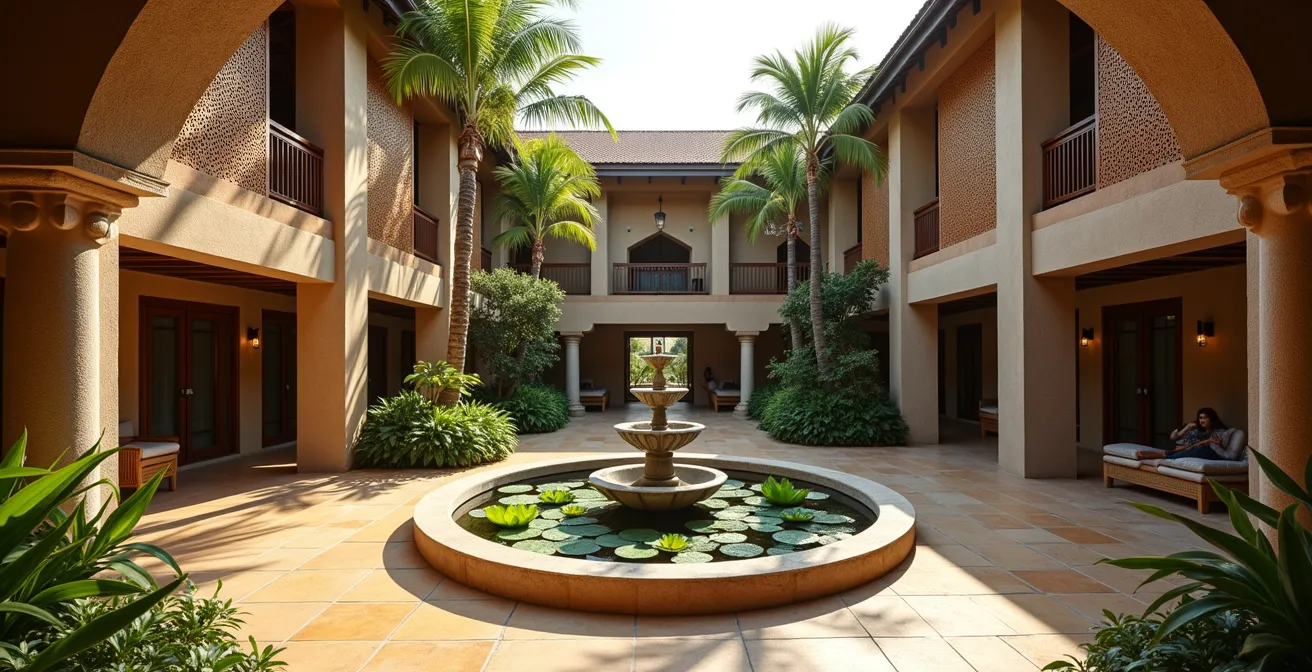
Designing a self-cooling hotel is not about adding eco-features; it’s about conceiving the building as a living organism that regulates its own temperature.
- Materials like mass timber are not just structural; they actively improve guest well-being by lowering stress indicators.
- Integrated systems like living roofs and intelligent orientation create a “thermal metabolism” that manages heat and water, drastically cutting energy needs and operational costs.
Recommendation: Shift from component-based “green” thinking to a holistic, ecosystem-level design philosophy for superior performance, guest experience, and profitability.
For developers and architects in tropical climates, the reliance on mechanical air conditioning presents a paradox. It’s a solution that simultaneously guarantees guest comfort while contributing to the very climate challenges that make it necessary. The conventional approach involves sealing a building and fighting the external environment with energy-intensive HVAC systems. Many projects attempt to mitigate this with add-ons: solar panels, green walls, or efficient windows. While valuable, these are often isolated remedies applied to a fundamentally flawed concept.
What if the core premise was different? What if, instead of a sealed box, the building was a living membrane—a porous, intelligent interface designed to breathe with its environment? This approach moves beyond simply reducing energy consumption and into the realm of biophilic design, where the building itself becomes an extension of the natural world. It’s a philosophy rooted in the understanding that natural materials and systems-based thinking can deliver superior thermal comfort and a profoundly deeper sense of well-being for occupants.
This guide delves into the principles of designing these self-regulating structures. We will explore how specific material choices directly impact human physiology, how to orchestrate natural elements like water and air, and how ancient vernacular wisdom can outperform modern technology. By the end, you will have a framework for creating hotels that don’t just sit in nature but are an active part of it, offering an unparalleled guest experience and a compelling business case.
To navigate this deep dive into bioclimatic design, the following sections will unpack the critical strategies and evidence-based principles. This summary provides a roadmap to creating buildings that are not only sustainable but truly alive.
Summary: Designing the Living Building
- Why Sleeping in a Timber Structure Lowers Your Heart Rate by 5 Beats?
- How to Install a Living Roof That Survives Droughts and Heavy Rain?
- Vernacular Techniques vs High-Tech Green: Which Is More Sustainable Locally?
- The Bamboo Maintenance Mistake That Causes Structural Rot in 3 Years
- How to Orient Your Building to Reduce Artificial Lighting Needs by 40%?
- How to Code a Website That Uses 40% Less Energy on Client Devices?
- Why Looking at Natural Fractals Reduces Your Stress Levels by 60%?
- How to Increase Your Home’s Resale Value by 15% With Smart Eco-Tech?
Why Sleeping in a Timber Structure Lowers Your Heart Rate by 5 Beats?
The choice of structural material is not merely an engineering decision; it is a physiological one. Modern design often isolates occupants from natural stimuli, creating sterile environments that require mechanical systems to feel comfortable. Timber, particularly when left exposed, re-establishes this crucial connection to the natural world. Its hygroscopic nature allows it to “breathe” with the indoor environment, passively regulating humidity to maintain a comfortable and healthy range. This effect reduces the load on dehumidifiers and creates a more pleasant ambient feeling.
Beyond humidity, the impact is neurological. The visual and tactile presence of wood has a documented calming effect on the human autonomic nervous system. This is a core principle of biophilic design: our bodies are hardwired to respond positively to natural materials and patterns. As pioneering research in the field has shown, this connection is measurable. As a study on the effects of wood in built environments highlights:
Wooden interiors can lower heart rates and reduce cortisol levels, contributing to a more calming and restorative environment.
– Fell (2010) and Tsunetsugu et al., Wood and human stress in the built indoor environment study
This isn’t an abstract theory. Projects like Heartwood in Seattle, the first mass timber workforce housing project in the U.S., are built on this premise. They prioritize occupant wellness by using exposed timber interiors to create restorative living spaces. For a hotel, this translates directly into a premium guest experience—offering a demonstrably more restful and healthy environment that can become a key marketing differentiator.
How to Install a Living Roof That Survives Droughts and Heavy Rain?
A living roof is one of the most powerful elements in a building’s thermal metabolism. It is far more than an aesthetic feature; it is an active system for managing heat and water. In a tropical climate, it acts as a thermal shield, its soil and plant layers absorbing solar radiation and preventing it from penetrating the building envelope. Through evapotranspiration, the plants actively cool the roof surface, creating a microclimate that can be significantly cooler than a conventional roof. This dramatically reduces the cooling load on the spaces below.
However, its success hinges on designing for climatic extremes: intense downpours and prolonged droughts. The key lies in a multi-layered substrate system designed for sophisticated hydrological choreography. This is not simply a layer of soil; it is an engineered ecosystem. The diagram below illustrates the critical components that ensure both resilience and performance.
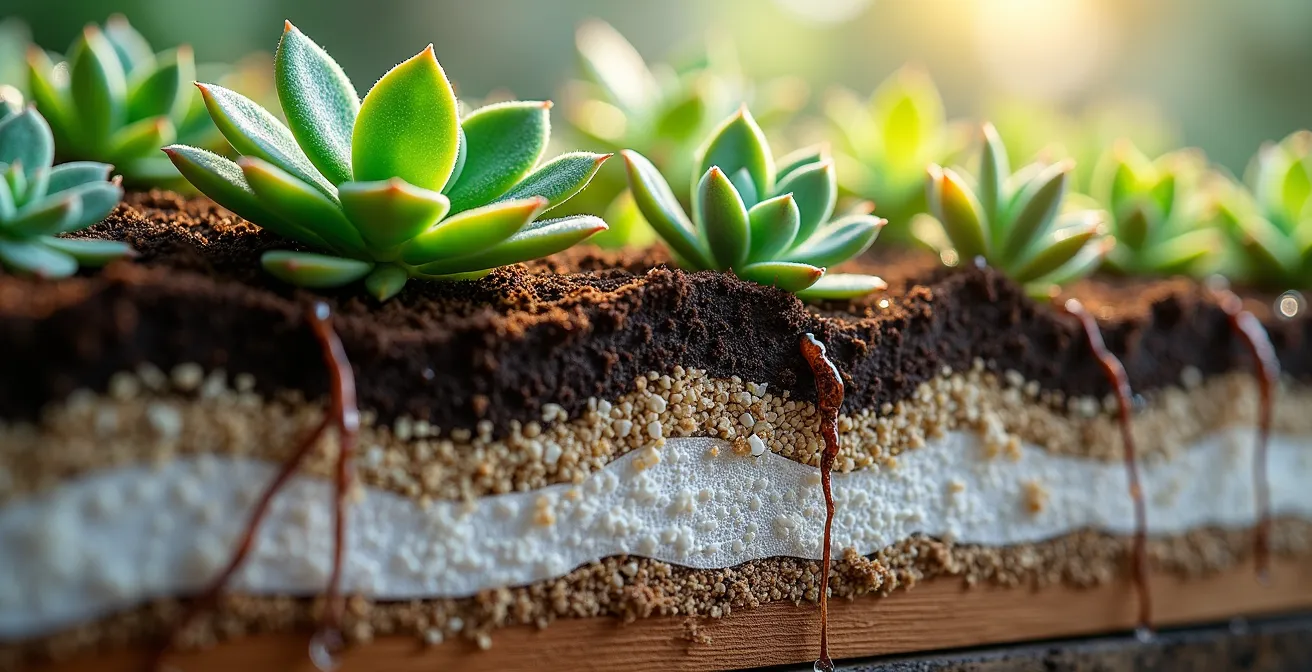
As the cross-section shows, success is built in layers. A drainage layer (often made of lightweight materials like perlite or gravel) is essential to quickly channel away excess water during heavy rain, preventing waterlogging and structural overload. Above this, a geotextile filter fabric prevents fine soil particles from clogging the drainage system. The growing medium itself must be carefully specified—a lightweight, engineered soil with good water retention capacity to sustain plants during dry spells, populated with drought-tolerant native species like succulents that are adapted to the local climate. Finally, a robust, root-resistant waterproofing membrane is non-negotiable to protect the building’s structure.
Vernacular Techniques vs High-Tech Green: Which Is More Sustainable Locally?
The drive for sustainability often leads to a focus on high-tech solutions: photovoltaic glass, automated shading systems, and geothermal heat pumps. While effective, these technologies come with high embodied carbon, significant initial costs, and a reliance on specialized maintenance. The push for such solutions is understandable, given that without a change in course, energy demand from air conditioning will triple by 2050. However, an alternative, often more resilient, path lies in embracing vernacular intelligence—the time-tested architectural strategies native to a region.
Vernacular techniques like thick rammed-earth walls, shaded courtyards with fountains, and strategically placed wind towers were developed over centuries to work *with* the local climate, not against it. They rely on fundamental physics—thermal mass, evaporative cooling, and convective airflow—and locally sourced materials. This approach results in buildings with extremely low embodied carbon and operational energy needs. For a hotel project, the choice between these two philosophies has profound implications for cost, resilience, and cultural authenticity. The following table provides a clear comparison of their lifecycle impacts.
| Aspect | Vernacular Techniques | High-Tech Solutions |
|---|---|---|
| Initial Cost | Low ($50-100/m²) | High ($200-500/m²) |
| Embodied Carbon | 10-50 kg CO₂/m² | 100-300 kg CO₂/m² |
| Maintenance | Local skills available | Specialized technicians |
| Lifespan | 30-50 years with regular care | 15-25 years |
| Energy Use | Zero operational energy | 5-20 kWh/m²/year |
| Cultural Integration | High local acceptance | Variable acceptance |
The data suggests that for long-term sustainability and local economic integration, vernacular approaches often hold a significant advantage. They foster local craftsmanship, reduce dependency on imported technology, and create a building that feels deeply rooted in its place. The most innovative projects often create a hybrid, using vernacular principles for the building’s passive “chassis” and integrating targeted high-tech solutions where they provide the most value, rather than as a default.
The Bamboo Maintenance Mistake That Causes Structural Rot in 3 Years
Bamboo is a phenomenal material for tropical construction—it has a tensile strength comparable to steel, grows incredibly fast, and sequesters carbon. It embodies the principles of sustainable design. However, its reputation is often tarnished by failures that are almost always attributable to one critical oversight: improper protection against water ingress, especially at the joints. An architect specifying bamboo must understand it not as a timber substitute but as a unique material with its own vulnerabilities.
The primary mistake is treating bamboo as a solid element. It is a hollow grass with a natural waterproof exterior, but any cut or joint exposes its fibrous interior to moisture. This is where rot begins. The most common point of failure is at knuckle and fish-mouth connections. If these joints are not meticulously designed and sealed, water wicks into the core, leading to fungal growth and structural degradation that can compromise the entire building within a few years. The image below highlights a correctly executed joint, where design and treatment work together to ensure longevity.

Ensuring durability requires a two-pronged approach. First, design for drainage. All joints should be designed to shed water, avoiding any geometry that could trap moisture. Horizontal members should have drainage holes (weep holes) to prevent water from accumulating inside the culms. Second, treatment and sealing are non-negotiable. The bamboo must be treated with boron-based preservatives to protect against insects and fungus. Following treatment, every cut end and joint surface must be sealed with appropriate materials, ranging from traditional natural resins to modern, flexible polymer sealants that can accommodate bamboo’s natural expansion and contraction.
How to Orient Your Building to Reduce Artificial Lighting Needs by 40%?
Before a single material is chosen, the most powerful design decision is made: the building’s orientation. In a tropical climate, the primary challenge is managing solar heat gain, particularly from the east and west, while maximizing useful, non-glaring daylight from the north and south. Proper orientation is the first and most impactful step in designing a building’s passive thermal strategy, capable of drastically reducing the need for both air conditioning and artificial lighting.
The ideal form for a hotel in the tropics is often a thin, elongated rectangle oriented along the east-west axis. This minimizes the surface area of the walls exposed to the intense, low-angle morning and afternoon sun. The longer north and south facades can then be opened up with deep overhangs, balconies, or brise-soleils. This architectural shading strategy blocks the high-angle midday sun while allowing diffuse, indirect natural light to penetrate deep into the interior spaces. This alone can reduce the need for artificial lighting during the day by over 40%, lowering both energy use and internal heat gains from fixtures.
This principle is validated by extensive research and application. For example, research by Pablo La Roche at Cal Poly Pomona has demonstrated that combining correct orientation with external shading can reduce cooling loads by 40-60%. His designs, often inspired by the central courtyards of Spanish vernacular architecture, use the building’s form to create shaded, cooler microclimates. Introducing features like evaporative cooling ponds or extensive planting in these courtyards can further lower ambient temperatures by 10-15°F without any mechanical input, pre-cooling the air before it even enters the building.
How to Code a Website That Uses 40% Less Energy on Client Devices?
The philosophy of a self-cooling hotel is one of holistic efficiency and harmony with the environment. This ethos should not stop at the physical walls of the building; it must extend to its digital presence. A hotel’s website is often a potential guest’s first interaction with the brand. A heavy, slow, and energy-intensive website contradicts the very principles of thoughtful, sustainable design that the building embodies. Just as we optimize the building for minimal energy use, we must optimize its digital footprint.
The energy consumption of a website occurs on two fronts: the server that hosts it and the client’s device (laptop, phone) that displays it. By applying principles of “green web development,” it’s possible to significantly reduce this consumption. This involves minimizing data transfer, reducing computational load, and making smart design choices. A lightweight, fast-loading site not only uses less energy but also provides a better user experience, especially for travelers in areas with poor connectivity. This demonstrates a consistency of philosophy that reinforces the hotel’s brand as genuinely sustainable.
Implementing these practices is a matter of technical discipline. The following checklist outlines concrete steps to build a more resource-efficient digital front door for your project, reflecting its physical commitment to sustainability.
Action Plan: Green Web Development for Sustainable Hospitality
- Static Site Generation: Implement static site generation (SSG) to pre-build pages, reducing server-side processing by up to 80% on each visit.
- Optimized Media: Use modern, efficient image formats like WebP or AVIF and implement lazy loading to cut initial page-load bandwidth by over 50%.
- Asset Minification: Minify all CSS and JavaScript files and enable server-side compression (like Gzip or Brotli) to achieve up to a 70% reduction in file transfer size.
- System Fonts: Design with system-native fonts (e.g., Arial, Helvetica, Georgia) to eliminate the 200-500KB download typically required for custom web fonts.
- Dark Mode Implementation: Implement an automatic dark mode that activates based on the user’s system preference or local sunset time, saving significant energy on OLED screens.
- Efficient Animations: Use CSS animations and transitions instead of JavaScript-based libraries for simple UI effects, resulting in up to 60% less CPU usage and smoother performance.
Why Looking at Natural Fractals Reduces Your Stress Levels by 60%?
The benefits of integrating nature into design go beyond thermal performance; they are deeply psychological. This is the domain of fractal attunement. Fractals are self-repeating patterns found everywhere in nature—the branching of trees, the veins of a leaf, the unfurling of a fern. Our brains have evolved to process these patterns with effortless fluency. Viewing them triggers an aesthetic and physiological response of relaxation and reduced stress.
When an environment is devoid of these natural complexities, our brains can experience a subtle form of stress. Conversely, exposure to mid-complexity fractals, the kind most common in nature, has been shown to reduce physiological stress levels by as much as 60%. This is why a view of a forest is more restorative than a view of a blank wall. A successful biophilic design intentionally incorporates these patterns into the building itself. This can be achieved through the grain of exposed wood, the patterns in natural stone, perforated screens that cast dappled light like a tree canopy, or the deliberate planting of foliage with fractal qualities.
This principle has a direct impact on guest well-being and is a cornerstone of healing environments, as noted by healthcare design researchers. This is a powerful concept for hospitality design, where guest restoration is paramount.
Biophilic design elements like abundant use of exposed wood and views of nature improve recovery, reduce patient stress and may even shorten the duration of hospital stays.
– Surrey Memorial Hospital research team, naturally:wood Building Performance study
Corporate environments are also leveraging this effect. The Google headquarters in Sunnyvale, California, makes extensive use of exposed mass timber, celebrating the natural fractal patterns in the wood grain. Post-occupancy studies there have shown a 20% improvement in employee focus and concentration, directly linking the biophilic environment to cognitive performance and well-being.
Key Takeaways
- A self-cooling building is a system, not a checklist. Success comes from integrating strategies, not just adding features.
- Material choice is a health choice. Natural materials like timber have a measurable, positive impact on human physiology and well-being.
- Vernacular wisdom is a powerful, low-carbon technology. It often provides more resilient and cost-effective solutions than imported high-tech systems.
How to Increase Your Home’s Resale Value by 15% With Smart Eco-Tech?
While the title references a home, the principle is even more potent in the hospitality sector: a well-designed, self-cooling hotel is not an expense, but a high-performing asset. Shifting from a reliance on conventional HVAC to a passive, biophilic design philosophy generates a powerful return on investment that manifests in multiple ways. It dramatically lowers operational costs, enhances the guest experience, and creates a powerful, authentic brand story that resonates with the growing market of eco-conscious and wellness-focused travelers.
This is not a purely altruistic endeavor; it’s a shrewd business strategy. Lower energy bills directly translate to higher net operating income (NOI). A unique, comfortable, and healthy environment allows the property to command premium rates and fosters exceptional guest loyalty. In fact, industry analysis reveals that hotels with natural cooling features can increase Revenue Per Available Room (RevPAR) by 20% and command premium rates that are 15-25% higher than their conventional counterparts. The following table breaks down the compelling financial case for investing in passive design over standard HVAC.
| Investment Type | Initial Cost | Annual Operating Cost | 5-Year ROI | Guest Satisfaction |
|---|---|---|---|---|
| Passive Cooling Design | +10-15% construction | $0-500/year | 150-200% | 92% positive |
| Conventional HVAC | Standard | $5000-15000/year | 20-40% | 65% positive |
| Hybrid System | +5-8% construction | $2000-5000/year | 80-120% | 85% positive |
The initial uplift in construction cost for a thoughtful passive design is an investment, not a cost center. As the data shows, this investment is paid back rapidly through operational savings and increased revenue, delivering a return that far outstrips conventional development models. By designing a building as a living membrane, you are not just creating a sustainable hotel; you are creating a more profitable and resilient long-term asset.
To begin applying these principles to your next project, the first step is to shift the design process. Start with a comprehensive climate analysis and a commitment to a holistic, systems-based approach, and build a team that values vernacular intelligence as much as modern innovation.
Frequently Asked Questions on Natural Building Materials
What is the most common cause of bamboo structural failure?
Water ingress at joints, particularly at knuckle and fish-mouth connections, causes the vast majority of bamboo failures. If these connections are not properly designed to shed water and sealed with appropriate resins or modern sealants, rot can compromise the structure in as little as three years in a humid climate.
How often should bamboo structures be inspected and treated?
In humid tropical climates, a thorough inspection should be conducted every 6 months. In drier climates, an annual inspection is sufficient. During inspection, check all joints for cracks or signs of moisture penetration and reapply boron-based preservatives as needed to maintain protection against insects and fungus.
Can laminated bamboo beams be used in high-humidity environments?
Yes, but with critical specifications. Laminated bamboo is only suitable for high-humidity applications if it is manufactured with marine-grade adhesives and protected with a complete vapor barrier coating. A critical risk is internal delamination due to humidity, which can be invisible until catastrophic failure occurs, so you must explicitly specify and verify the use of humidity-resistant lamination.