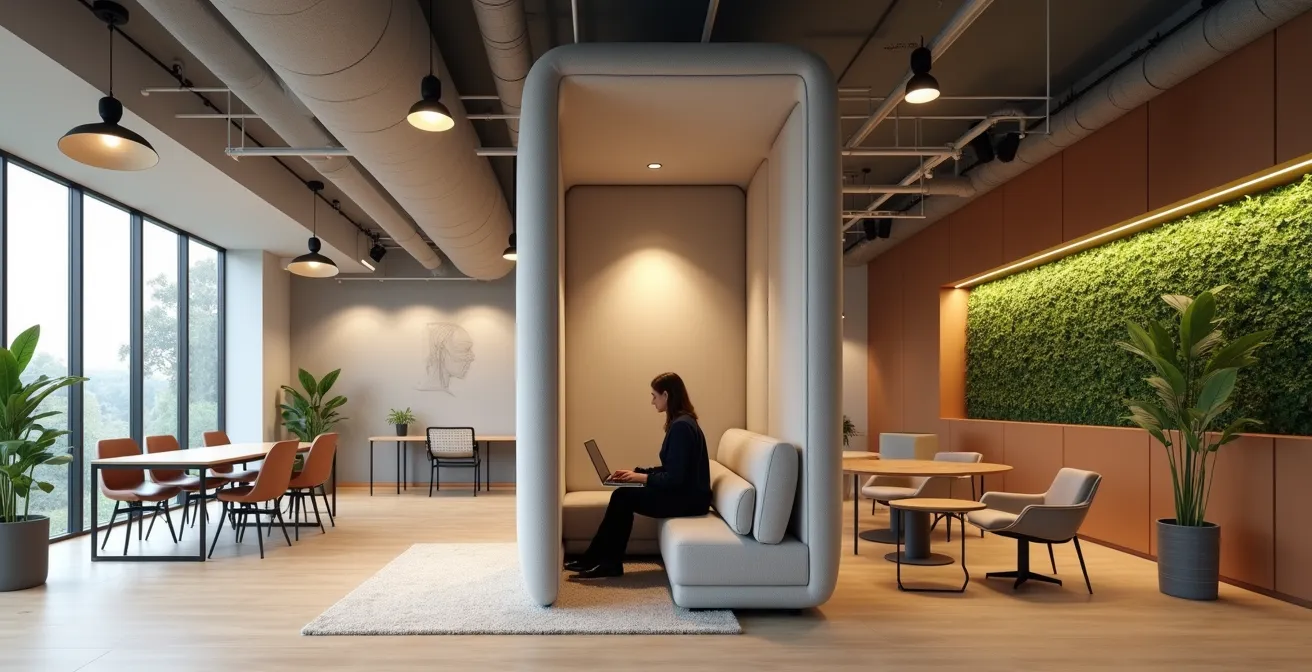
Contrary to popular belief, achieving acoustic privacy is not about creating silence; it’s about systematically engineering an environment where distracting speech becomes unintelligible.
- Effective quiet zones rely on the “ABC” framework: Absorb sound, Block its path, and Cover residual noise with masking technologies.
- Physical barriers like glass walls often fail due to “flanking paths”—hidden gaps in ceilings, floors, and ductwork that sound travels through.
Recommendation: Shift your focus from simply adding soundproofing materials to conducting a thorough acoustic audit that identifies and mitigates speech intelligibility and flanking transmission paths.
For any professional managing a shared space—be it a library, airport terminal, or open-plan office—the promise of a “quiet zone” often feels like a mirage. You invest in stylish acoustic panels and designate areas for focus, yet the persistent hum of distant conversations continues to shatter concentration. The common advice focuses on adding soft materials or building walls, treating noise as a monolithic problem to be absorbed or blocked. This approach is fundamentally flawed because it misunderstands the primary enemy of focus.
The real issue isn’t loudness; it’s speech intelligibility. The human brain is hardwired to process language, and even a fragment of an overheard conversation can hijack our cognitive resources. But what if the solution wasn’t simply to build higher walls, but to strategically control the entire acoustic environment? The key lies not in chasing an unrealistic goal of absolute silence, but in applying acoustic engineering principles to make distracting speech unintelligible, thereby freeing the brain to focus.
This guide moves beyond generic tips to provide a scientific framework for designing and implementing truly effective quiet zones. We will dissect the cognitive impact of noise, evaluate the cost-effectiveness of different technologies, expose common design flaws, and provide a systematic plan for creating an acoustic ecosystem that protects confidentiality and promotes deep work.
Contents: How to Scientifically Engineer Acoustic Privacy
- Why Does Overhearing Conversations Drop Your Concentration by 66%?
- How to Use “Pink Noise” Emitters to Create Privacy in Open Spaces?
- Soundproofing Materials vs Electronic Masking: Which Is More Cost-Effective?
- The “Glass Box” Mistake: Why Visual Walls Don’t Stop Meeting Confidentiality Leaks?
- When to Schedule “Quiet Hours” to Match Natural Biological Rhythms?
- How to Integrate Video Tools to Reduce “Zoom Fatigue” by 50%?
- The Acoustic Mistake That Makes Confidential Meetings Impossible in Flex Offices
- How to Design a Flexible Workspace That Actually Encourages Return to Office?
Why Does Overhearing Conversations Drop Your Concentration by 66%?
The disruptive power of nearby conversations is not a matter of personal sensitivity; it is a well-documented cognitive phenomenon. The core issue is the “irrelevant speech effect,” where the brain’s linguistic processing centers are involuntarily activated by intelligible words. Unlike a steady, non-linguistic sound like an air conditioner, human speech demands cognitive resources, pulling your attention away from the primary task. Research confirms the startling impact of this effect, showing that for many, there is a 66% productivity drop from just one nearby conversation.
This cognitive drain occurs because your brain is trying to perform two tasks at once: concentrating on your work and subconsciously decoding the overheard speech. The more intelligible the speech, the greater the cognitive load and the more significant the drop in performance. The goal of acoustic design, therefore, is not to eliminate all sound, but to reduce speech intelligibility to a point where the brain no longer tries to process it as language. This is typically achieved when the signal-to-noise ratio makes it impossible to understand more than 50% of the words being spoken.
Effectively managing this requires a multi-faceted strategy. It involves protecting your most productive hours from speech exposure, using technology to mask the specific frequencies of human speech (typically 500-4000 Hz), and using physical distance to your advantage. By understanding that the problem is intelligibility, not volume, you can shift from ineffective “quiet policies” to scientifically-backed environmental design.
How to Use “Pink Noise” Emitters to Create Privacy in Open Spaces?
Electronic sound masking is a cornerstone of modern acoustic design, and “pink noise” is one of its most effective tools. Unlike white noise, which has equal energy across all frequencies and can sound harsh or hissy, pink noise is specifically engineered to be more pleasant to the human ear. Its power decreases as the frequency increases, resulting in a sound often compared to a gentle waterfall or steady rain. This characteristic makes it exceptionally good at masking the frequencies of human speech, which is the primary goal.
Sound masking emitters are small, specialized speakers, often installed in the ceiling plenum, that distribute a uniform, unobtrusive layer of pink noise throughout a space. The purpose is not to “drown out” sound, but to raise the ambient background noise level just enough to reduce speech intelligibility. When a conversation occurs, the masking sound mixes with the speech, making the words indistinct and therefore less distracting to anyone outside the immediate area. This creates a “bubble” of conversational privacy without the need for solid walls.
The implementation is a precise process. Acoustic engineers measure the existing ambient noise and then calibrate the masking system to a specific level, typically around 45-48 decibels, which is comfortable for occupants. The emitters, with their carefully designed perforated surfaces, ensure the sound is dispersed evenly, preventing “hot spots” where the noise is too loud or “dead spots” where it is ineffective. The result is an environment where you are aware of activity but are not cognitively burdened by it.
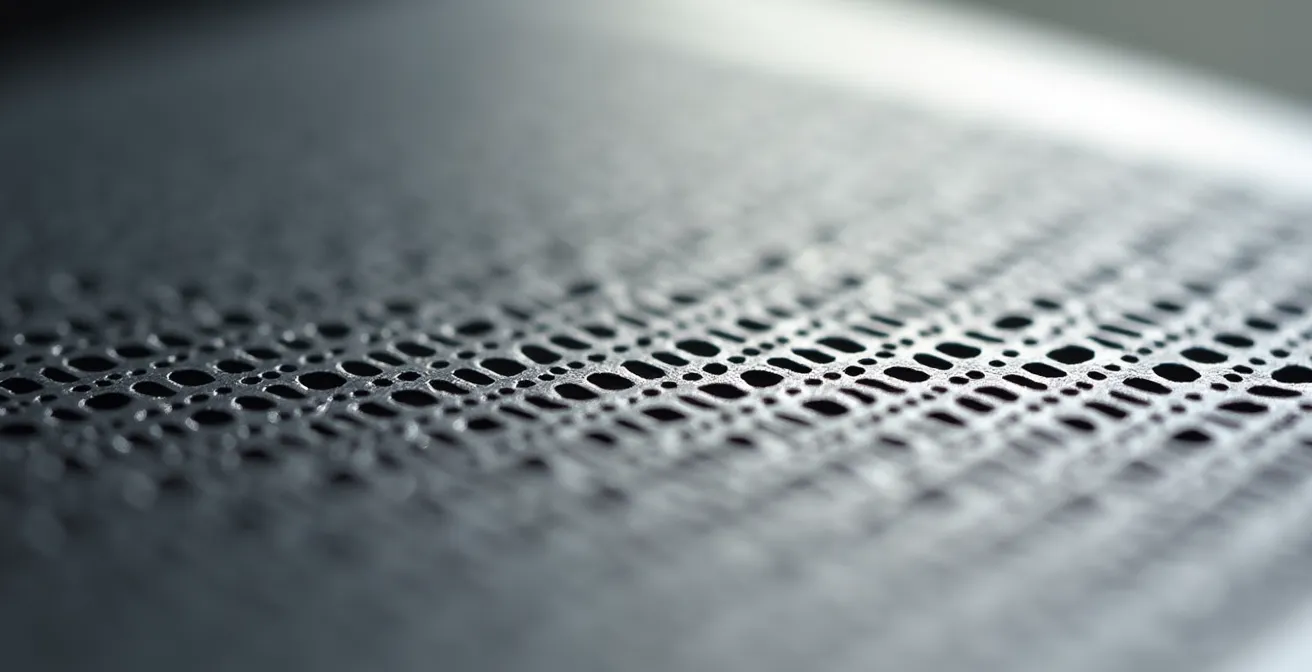
As shown in the detail above, the engineering of these emitters is focused on creating a diffuse sound field. This technological approach is a critical component of the “Cover” strategy in a comprehensive acoustic plan, working in tandem with physical absorption and blocking.
Soundproofing Materials vs Electronic Masking: Which Is More Cost-Effective?
When faced with a noise problem, the default instinct is often to build physical barriers—more drywall, thicker glass, denser insulation. While these soundproofing materials play a crucial role, relying on them exclusively is frequently the least cost-effective approach. A truly efficient solution balances physical soundproofing with electronic sound masking in a comprehensive “Acoustic Ecosystem.” This integrated strategy is often referred to as the “ABC” framework: Absorb, Block, and Cover.
– Absorb: This involves using soft, porous materials like acoustic panels, carpets, and ceiling tiles to reduce sound reverberation and echo within a space. Absorption improves sound quality but does little to prevent sound transmission between rooms.
– Block: This is the role of soundproofing materials. Mass-heavy elements like multiple layers of drywall, mass-loaded vinyl, and solid-core doors are used to physically stop sound waves from passing through a partition. This is effective but can be extremely expensive and structurally demanding.
– Cover: This is the function of electronic sound masking (e.g., pink noise). It introduces a neutral, engineered background sound to cover, or mask, residual speech noise that was not fully absorbed or blocked, thus reducing its intelligibility.
Experience from seasoned professionals demonstrates the financial advantage of a combined approach. For example, NYC-based soundproofing firm Quiet Zone found through thousands of projects that combining the ABC framework can achieve a 90% noise reduction at 40% less cost than using physical soundproofing alone. Attempting to achieve a high Sound Transmission Class (STC) rating with blocking materials alone leads to diminishing returns, where each additional decibel of reduction becomes exponentially more expensive. By using sound masking to handle the last few decibels of privacy, designers can specify less massive, more affordable wall constructions while achieving superior results.
The “Glass Box” Mistake: Why Visual Walls Don’t Stop Meeting Confidentiality Leaks?
The modern aesthetic of glass-walled meeting rooms promotes transparency and light, but it is an acoustic nightmare. Glass is a highly reflective, non-porous surface that does very little to block sound unless it is specialized, laminated acoustic glass—which is prohibitively expensive for most projects. However, the biggest mistake designers make is assuming the wall itself is the only point of failure. Confidentiality is most often breached not through the wall, but around it, through what engineers call “flanking paths.”
Flanking paths are hidden routes that sound waves take to bypass a partition. A wall might have a high STC rating, but if there are gaps, the entire assembly fails. In a typical “glass box” office, sound easily travels over the wall through a shared ceiling plenum, through unsealed gaps around the door, via interconnected HVAC ducts, or even through back-to-back electrical outlets. This is why you can often understand every word of a “private” meeting from 20 feet away, despite the visual barrier of the glass.
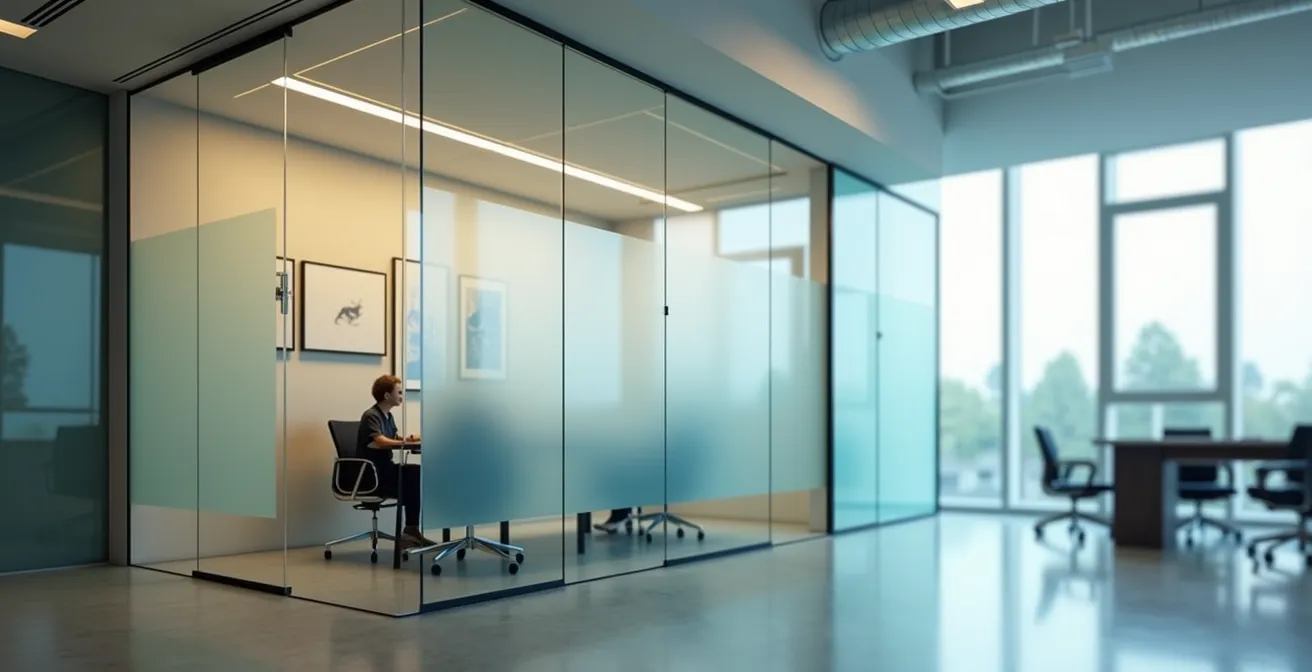
As this image suggests, achieving privacy in a transparent room requires treating the entire system. This means extending walls from the floor slab to the deck above the ceiling, installing acoustic baffles in ductwork, and using high-quality seals on all doors and penetrations. Simply specifying a thick glass wall without addressing these flanking paths is a waste of resources and creates a false sense of security.
Action Plan: Flanking Path Detection Checklist
- Ceiling Plenum: Does the wall extend all the way to the structural deck above the dropped ceiling, or does it stop at the tile level?
- Door Seals: With the door closed, can you see light coming through gaps around the frame, top, or bottom? Are proper acoustic seals and an automatic door bottom installed?
- HVAC Connections: Do air ducts create a direct, unbaffled connection between the confidential room and adjacent spaces?
- Floor Junctions: Are there unsealed gaps where the base of the walls meets the floor, particularly with raised flooring systems?
- Electrical Penetrations: Are electrical or data outlets installed back-to-back on the same stud, creating a direct hole through the wall?
This audit, based on established principles from sources like a guide to designing quiet offices, is non-negotiable for any space where confidentiality is required.
When to Schedule “Quiet Hours” to Match Natural Biological Rhythms?
Beyond physical and electronic solutions, an effective acoustic strategy must incorporate a human-centric, organizational layer. Implementing “quiet hours” is a common policy, but its success hinges on scheduling these periods to align with the natural biological rhythms of the users, a field known as chronobiology. People’s peak times for focus and concentration are not uniform; they are largely determined by their chronotype—whether they are a morning person (“lark”), an evening person (“owl”), or somewhere in between (“third bird”).
Imposing a blanket “9-11 AM quiet time” may serve the larks in your organization well but could be counterproductive for the owls, who may only be reaching peak cognitive performance in the late afternoon. A more sophisticated approach involves creating a schedule that accommodates the focus needs of different chronotypes, or at least aligns with the patterns of the majority. By acknowledging these biological realities, you can design a policy that supports productivity instead of hindering it.
The following table provides a framework for scheduling quiet and collaborative periods based on an analysis of common chronotypes. While individual patterns vary, this data-driven approach offers a more effective starting point than arbitrary scheduling.
| Chronotype | Peak Focus Time | Recommended Quiet Hours | Collaboration Windows |
|---|---|---|---|
| Early Birds (25%) | 8:00-10:00 AM | 7:30-10:30 AM | 2:00-4:00 PM |
| Third Birds (50%) | 10:00 AM-12:00 PM | 9:30-11:30 AM | 2:00-4:00 PM |
| Night Owls (25%) | 4:00-6:00 PM | 3:00-5:00 PM | 10:00 AM-12:00 PM |
This strategic scheduling, informed by research from sources like Worktech Academy’s analysis of productivity and acoustics, can be complemented by other rhythmic approaches, such as the 90-minute “ultradian rhythm” work sprints. The key is to move from a one-size-fits-all policy to an evidence-based system that respects human biology.
How to Integrate Video Tools to Reduce “Zoom Fatigue” by 50%?
In today’s hybrid work environments, the acoustic ecosystem extends beyond the physical office into the digital realm. The phenomenon of “Zoom fatigue” is a real neurological burden, driven in large part by poor audio quality and the high cognitive load of processing distorted sound and managing overlapping conversations. An unmanaged digital audio environment is as disruptive as a noisy open office. Integrating video tools correctly is therefore an acoustic challenge as much as a technological one.
The primary goal is to create a clean, predictable, and low-effort listening experience. This requires moving beyond default settings and implementing a strict “audio-first” meeting protocol. The focus shifts from visual presence to auditory clarity. Mandating the use of professional headsets with built-in noise cancellation for all participants is the first step. This single measure drastically reduces the amount of background noise and room echo entering the meeting, lowering the collective cognitive load for everyone.
Further engineering the audio experience involves both policy and technology. Implementing a “speaker queue” system prevents the crosstalk and audio overlap that force brains to work overtime trying to parse multiple inputs. Defaulting to “cameras-off” for non-visual meetings also helps, as it reduces the cognitive resources dedicated to interpreting non-verbal cues, allowing for greater focus on the auditory information. Finally, leveraging AI-powered noise suppression tools can actively eliminate unpredictable background sounds—a barking dog, a siren—at the source, creating a pristine audio channel for all. This is not about technology for technology’s sake; it’s about using tools to create a less demanding and more productive digital acoustic space.
The Acoustic Mistake That Makes Confidential Meetings Impossible in Flex Offices
Flexible and co-working spaces present a unique and severe acoustic challenge. Their very nature—demountable walls, modular construction, and a focus on reconfigurability—often prioritizes agility over acoustic performance. The most critical and common mistake is the use of partition walls that do not extend from the structural floor slab to the structural ceiling deck. Instead, they stop at the height of the dropped ceiling, creating a massive, shared-air plenum that acts as a highway for sound.
This single construction shortcut renders any claim of confidentiality null and void. A meeting room could be built with walls having a theoretical STC rating of 50, but if there is an open-air path over the top, the effective STC rating of the assembly plummets to 20 or less—the equivalent of a standard hollow-core door. Conversations become fully intelligible in adjacent rooms. This is the most prevalent flanking path in flex office construction, and it is a non-negotiable dealbreaker for any tenant requiring speech privacy.
For designers and facility managers, conducting proper acoustic due diligence before signing a lease or beginning a build-out is essential. This includes requesting STC documentation for all partitions, but more importantly, physically verifying that walls are “full-height” to the deck. A simple speech privacy test—having one person talk in a normal voice inside a room while another listens outside—can quickly reveal major deficiencies. For situations where permanent construction is not an option, innovative solutions are required. A case study on portable acoustic solutions by ROCKWOOL shows that combining high-density portable screens (with a Noise Reduction Coefficient of 0.85 or higher) and localized sound masking can create temporary zones with adequate speech privacy, often at 80% less cost than permanent construction.
Key Takeaways
- A true quiet zone is an “Acoustic Ecosystem” that balances the ABCs: Absorbing echo, Blocking sound paths, and Covering residual noise.
- The primary goal is not silence, but reducing speech intelligibility to a level where the brain is no longer distracted by it.
- Most soundproofing failures are due to flanking paths—hidden gaps around walls, ceilings, and doors—not the wall material itself.
How to Design a Flexible Workspace That Actually Encourages Return to Office?
In the post-pandemic era, the office is no longer just a place to work; it’s a destination that must offer a compelling experience that surpasses the home office. A primary reason employees hesitate to return is the inability to focus in a noisy, distracting environment. Therefore, designing a flexible workspace with a sophisticated acoustic zoning strategy is not a luxury—it is a fundamental requirement for encouraging a return to the office. The one-size-fits-all open plan is dead; it must be replaced by a purposefully designed ecosystem of diverse acoustic environments.
This strategy involves dividing the entire floorplan into distinct zones, each with a defined purpose and a corresponding acoustic profile. This allows employees to choose an environment that matches the cognitive demands of their current task. From high-energy collaborative hubs to library-quiet deep focus zones, each space is engineered with a specific decibel level and set of acoustic features. This approach provides the control and choice that employees value in their home offices, but within a collaborative and resource-rich community setting.

An acoustic zoning masterplan is the blueprint for this new type of workplace. It goes far beyond simply scattering a few pods and phone booths. It is a holistic plan that considers adjacencies, circulation paths, and the specific combination of absorption, blocking, and covering needed for each zone to function as intended. Such a framework provides clarity for both designers and users, transforming the office from a source of distraction into a powerful tool for productivity.
This table outlines a typical framework for creating a multi-zoned acoustic environment, as suggested by an analysis of creating privacy in the workplace, which serves as a starting point for any modern office design.
| Zone Type | Noise Level (dB) | Activities | Acoustic Features |
|---|---|---|---|
| Library Zone | <40 dB | Deep focus work | Full enclosure, sound masking, acoustic panels |
| Focus Zone | 40-45 dB | Individual work | Semi-enclosed pods, ceiling baffles |
| Lounge Zone | 45-55 dB | Quiet collaboration | Soft furnishings, area rugs, plants |
| Hub Zone | 55-65 dB | Active collaboration | Open layout with acoustic clouds |
By moving beyond outdated concepts and applying these engineering principles, you can transform any shared space from a source of cognitive friction into an environment that actively supports focus, confidentiality, and well-being. The next step is to begin auditing your own space not just for noise, but for the critical factor of speech intelligibility.