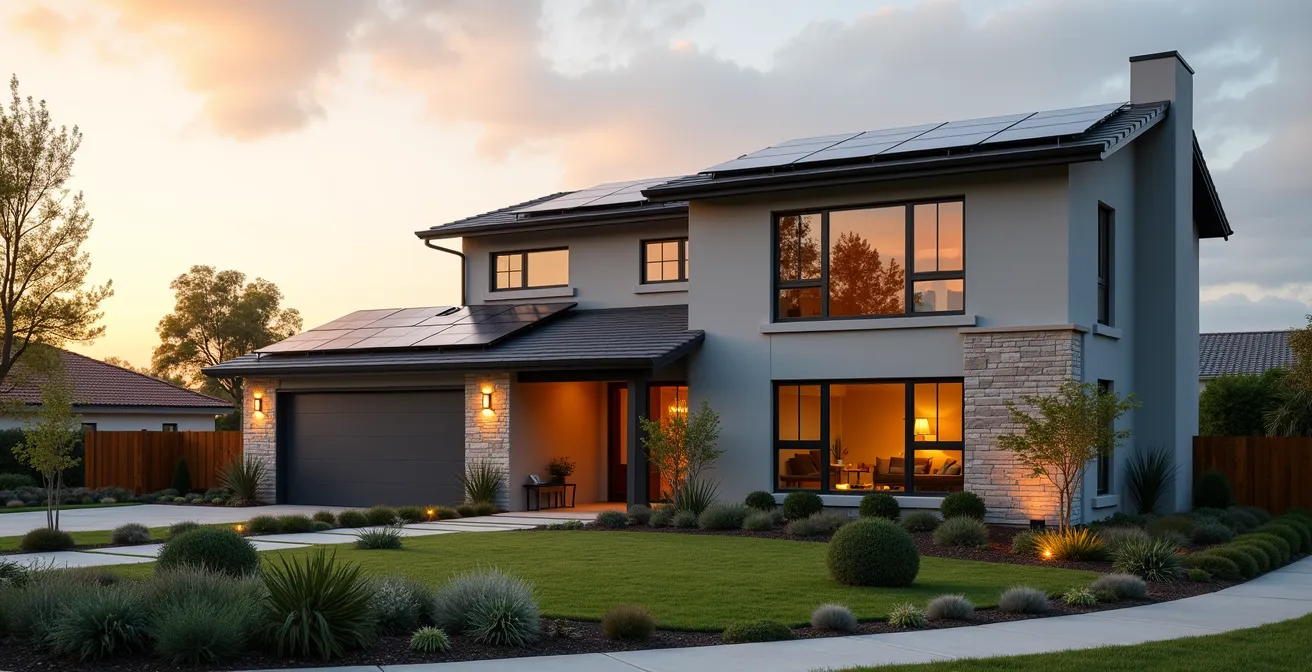
Smart eco-tech boosts a home’s value not through trends, but by creating quantifiable financial returns and lowering operational risk.
- Targeted upgrades like smart thermostats and solar panels offer demonstrable ROI through energy savings and direct valuation premiums.
- Centralized, user-friendly control systems are more valuable to buyers than a collection of disconnected gadgets.
Recommendation: Prioritize technology investments with clear, documentable operational savings and ensure they are seamlessly integrated for maximum buyer appeal and resale value.
For homeowners and real estate investors, maximizing property value is a constant goal. Traditional wisdom points toward kitchen remodels or bathroom upgrades, but these renovations are often costly, disruptive, and offer unpredictable returns. Many now turn to technology, believing that adding a few “smart” gadgets will automatically attract modern buyers. The market is flooded with advice to simply install a smart speaker or connected light bulbs.
But what if the key to a significant valuation increase isn’t about trendy features, but about strategic financial instrumentation? The true potential of eco-tech lies not in the novelty of the device, but in its proven ability to function as a financial asset. These technologies generate tangible operational savings, mitigate long-term risks like rising energy costs, and position a property as a superior, future-proof investment. This is where a home’s value can genuinely climb.
This guide moves beyond the hype to provide a clear-eyed, financial analysis. We will deconstruct how specific, high-impact green technologies translate directly into a higher selling price. By treating your home as an asset and your upgrades as investments, you can unlock a valuation premium that far exceeds the initial cost. We will explore the concrete ROI of each system, from the immediate payback of smart climate control to the long-term equity boost of solar integration, providing a blueprint for profitable and sustainable renovation.
To navigate this landscape of profitable eco-upgrades, this article breaks down the essential components that drive real financial returns. The following sections offer a detailed roadmap, examining the specific technologies that deliver the highest ROI and how to implement them for maximum impact on your home’s final sale price.
Summary: The Investor’s Guide to Eco-Tech Home Valuation
- Why Do Smart Thermostats Pay for Themselves in Less Than 2 Winters?
- How to Connect Solar Panels to Your Smart Home Hub for Maximum Efficiency?
- Passive House vs Smart Home: Which Certification Attracts Higher Paying Tenants?
- The “Smart” Lock Failure That Can Leave You Locked Out for Days
- How to Reduce Your Garden’s Water Bill by 50% Using IoT Sensors?
- When to Automate Household Chores: The ROI of Smart Home Investments
- How to Code a Website That Uses 40% Less Energy on Client Devices?
- How to Reduce Facility Management Costs by 20% Using Centralized IoT Controls?
Why Do Smart Thermostats Pay for Themselves in Less Than 2 Winters?
A smart thermostat is often the entry point into home automation, but its financial impact is frequently underestimated. The device’s value isn’t just in convenience; it’s in its ability to generate consistent, measurable operational savings. While the EPA’s Energy Star program suggests a baseline of around 8% savings on energy bills, real-world data paints an even more compelling picture of the return on investment (ROI). The core function of these devices is to eliminate waste by learning occupancy patterns and adjusting climate control automatically.
Studies of actual Nest customers, for instance, show that smart thermostats can deliver substantial results, with average savings between 10-12% on heating and 15% on cooling. For the average customer, this translates into an estimated savings of roughly $140 per year on energy bills. With a typical smart thermostat costing between $200 and $250, the payback period is often under two years. This rapid ROI makes it one of the most financially sound eco-tech upgrades available.
To a potential buyer, this isn’t just a gadget; it’s a promise of lower monthly expenses from day one. By highlighting these documented savings, you transform a simple feature into a powerful financial incentive. Maximizing this return involves using features like geofencing to detect when the home is empty, setting intelligent schedules via user-friendly apps, and regularly monitoring the energy usage reports provided by the device. This data provides concrete proof of the home’s efficiency, a key selling point for any financially savvy buyer.
How to Connect Solar Panels to Your Smart Home Hub for Maximum Efficiency?
Solar panels represent a significant capital investment, but their impact on resale value is direct and increasingly substantial. The modern value proposition of solar extends beyond just generating electricity; it’s about integrating this power source into a centralized smart home ecosystem for optimized consumption and management. This integration turns a passive energy source into an active asset that buyers can control and monitor, amplifying its appeal. The financial upside is clear and growing.
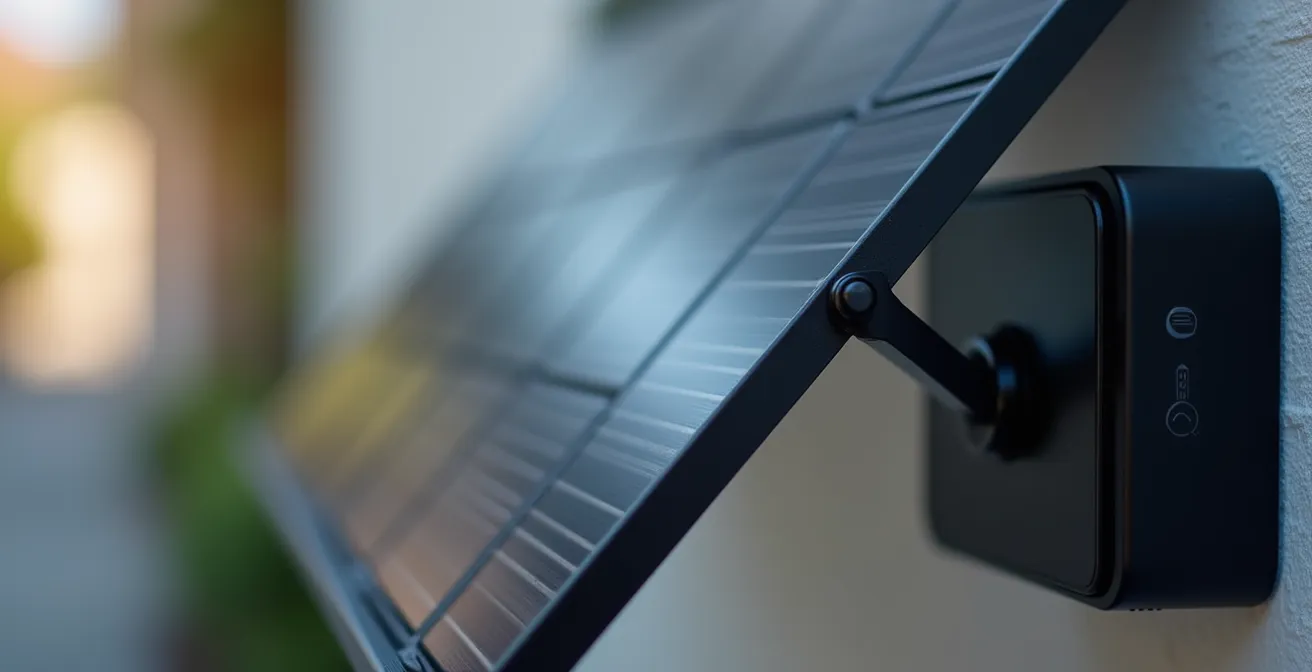
Recent data underscores this trend, showing that the “valuation premium” for solar-equipped homes is on the rise. While older studies showed a respectable increase, recent 2024 data shows homes with solar panels sell for 6.9% more than comparable non-solar homes. This premium reflects a market that increasingly values energy independence and reduced operational costs. When solar is connected to a smart hub, homeowners can direct energy to high-demand appliances during peak production, charge electric vehicles, or optimize battery storage, demonstrating a level of control that savvy buyers prize.
The following table illustrates how the perceived value of solar installations has appreciated over time, making it a stronger investment today than ever before.
| Study | Year | Value Increase |
|---|---|---|
| Zillow Original | 2019 | 4.1% |
| SolarReviews | 2024 | 6.8% |
| SolarInsure | 2024 | 5-10% |
This upward trend confirms that solar is not merely an environmental choice but a sound financial one. For a seller, presenting a home with an integrated solar and smart hub system showcases a property that is not only cheaper to run but also technologically advanced and future-proof.
Passive House vs Smart Home: Which Certification Attracts Higher Paying Tenants?
When appealing to high-value buyers or tenants, two paths emerge: the deep-energy efficiency of Passive House standards and the convenience-driven world of the smart home. While a full Passive House certification is the gold standard for low energy consumption, its high upfront cost and technical complexity can be a barrier. A strategically implemented smart home, on the other hand, can deliver a significant valuation boost with a lower initial investment. The key is understanding what buyers are willing to pay a premium for.
According to a report from the National Association of Realtors, the influence of smart home features is quantifiable. The report found that for 11% of buyers, the presence of smart technology was a deciding factor in their home purchase, with these features potentially enhancing a property’s resale by up to 5%. This demonstrates a clear market appetite for the convenience and perceived modernity that smart technology offers. Buyers understand and are willing to pay for features like automated lighting, security, and climate control that improve their daily lives.
Case Study: The Geographic ROI of Energy Efficiency
The financial return on energy-efficient upgrades like solar is not uniform; it’s heavily influenced by local energy costs and climate. For example, in high-cost urban centers like New York City, solar panels can elevate a home’s value by a significant 5.4%. In contrast, in sun-drenched but lower-cost areas like Riverside, California, the increase is a more moderate 2.7%. This demonstrates that the premium buyers are willing to pay is directly tied to the tangible, location-based savings they can expect.
Ultimately, a hybrid approach often yields the best ROI. Instead of pursuing a costly full certification, focusing on smart tech that demonstrably lowers utility bills—like smart thermostats and integrated solar—offers a more accessible and widely understood value proposition. It combines the financial benefits of efficiency with the modern appeal of automation, creating a compelling package for a broader range of high-paying buyers and tenants.
The “Smart” Lock Failure That Can Leave You Locked Out for Days
A smart lock is a powerful tool for security and convenience, but if mismanaged during a home sale, it can transform from a valuable asset into a major liability. The “failure” of a smart lock is rarely mechanical; it’s almost always a failure of process. When sellers don’t properly transfer ownership, new buyers can find themselves unable to control their own front door, create new access codes, or revoke old ones. This creates a significant security risk and a frustrating experience that can sour a deal or lead to post-sale disputes.
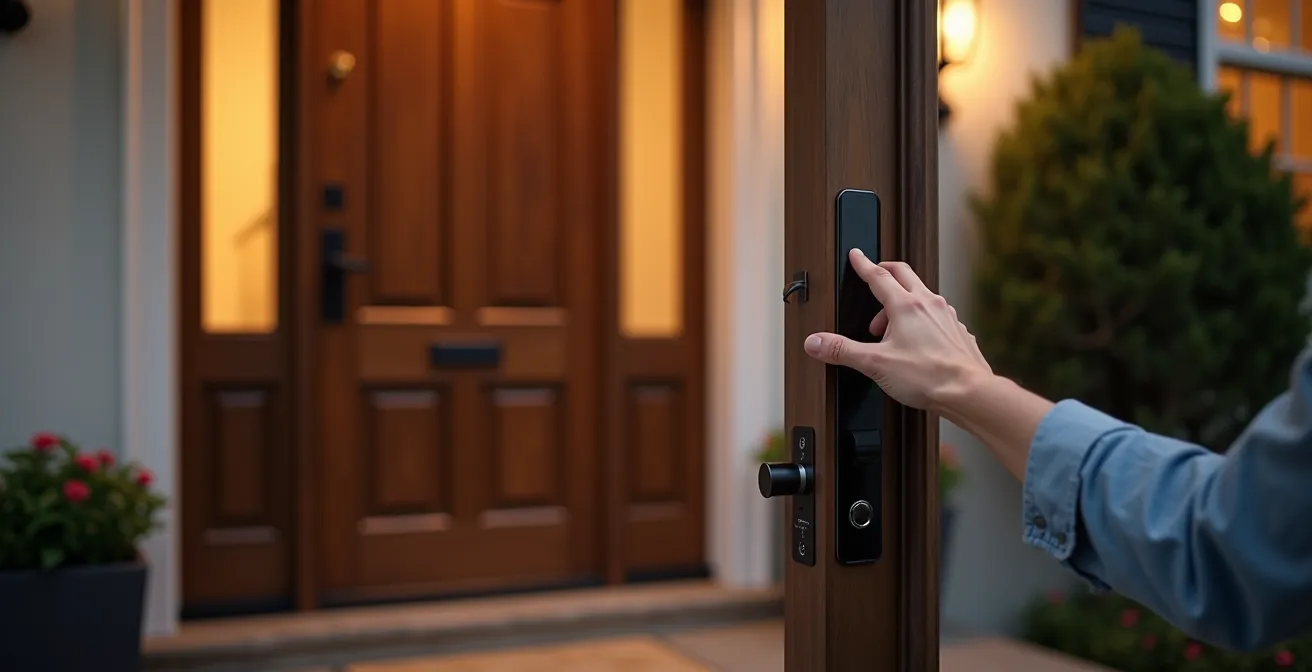
From a real estate perspective, the value of a smart lock lies in its ability to offer controlled, keyless access. For an investor, this means easily granting temporary access to maintenance staff or new tenants remotely. For a homeowner, it means convenience and peace of mind. However, to realize this value at resale, the transfer of this digital asset must be as meticulously planned as the transfer of the physical property. This involves more than just handing over a key; it requires a clear protocol for account migration, warranty transfers, and documentation of all backup access methods.
Failing to do this not only negates the value of the upgrade but can actively detract from the home’s appeal. A buyer who feels insecure or locked out of their new home’s features will not perceive the technology as a premium. Therefore, a proper handover is not just good practice; it’s essential for ensuring the smart lock contributes positively to the final sale price.
Action Plan: Smart Lock Handover for a Seamless Sale
- Document all access: List all users with digital keys and outline the manual override procedures and backup access methods.
- Consolidate hardware: Ensure all necessary components, such as Wi-Fi adapters like the August Connect for remote control, are included in the sale.
- Transfer ownership officially: Follow the manufacturer’s specific procedures for transferring account ownership and any active warranties to the new owner.
- Provide clear instructions: Create a simple guide for the new owner on how to set up their account, change primary access, and manage the system.
- Reset and confirm: Before closing, work with the buyer to ensure all previous digital keys are revoked and they have successfully established full administrative control.
How to Reduce Your Garden’s Water Bill by 50% Using IoT Sensors?
Curb appeal is a classic driver of home value, but in an era of increasing water costs and conservation awareness, a lush, green lawn can also signal high maintenance and expensive water bills to a potential buyer. This is where smart irrigation systems, powered by Internet of Things (IoT) sensors, transform a potential liability into a compelling asset. By automating watering based on real-time data, these systems maintain a beautiful landscape while drastically cutting water consumption—a dual benefit that resonates strongly with modern buyers.
The demand for this kind of intelligent home management is high; one survey found that 81% of buyers would be more interested in a home with smart technology already installed. A smart irrigation system is a perfect example of technology that offers a clear and immediate benefit. Unlike a traditional sprinkler on a timer, a smart system uses soil moisture sensors and local weather forecast data to water only when and where it’s needed. This prevents overwatering, reduces waste, and can lower water bills by up to 50%.
For a seller, this provides a powerful narrative. You’re not just selling a house with a nice garden; you’re selling a property with a self-managing, cost-efficient landscape. This is particularly valuable in regions where water is expensive or subject to conservation restrictions. Documenting the water savings before and after installation provides concrete proof of the system’s value, turning an invisible upgrade into a quantifiable selling point that justifies a higher asking price. It demonstrates a commitment to both sustainability and low operational costs, a winning combination for today’s homeowners.
When to Automate Household Chores: The ROI of Smart Home Investments
The decision to invest in a smart home ecosystem shouldn’t be driven by novelty but by a calculated assessment of its return on investment (ROI). While it might seem expensive to outfit an entire home with smart technology, the total cost is often a surprisingly small fraction of the property’s overall value. The key is to focus on a core set of high-impact devices that offer demonstrable benefits in energy savings, security, and convenience—the three pillars that buyers value most.
A strategic investment in automation doesn’t have to break the bank. In fact, a comprehensive upgrade covering key areas can be remarkably affordable. According to one analysis, upgrading six core smart devices costs about $1,000, which represents less than 1% of the average U.S. home’s value. This small, targeted investment can unlock a valuation premium of up to 5%, representing an exceptional ROI. The trick is choosing the right devices.
The highest returns come from automating fundamental household systems rather than just adding superficial gadgets. A smart thermostat, a smart lock, an integrated security system, and smart lighting in key areas form a powerful and cohesive package. When presented to a buyer, this isn’t just a collection of devices; it’s a unified system that makes the home more efficient, secure, and easier to manage. This holistic benefit is far more valuable than the sum of its parts and is what justifies the price premium at resale.
How to Code a Website That Uses 40% Less Energy on Client Devices?
Just as a well-coded website provides a fast, intuitive, and seamless user experience, a home’s smart technology ecosystem must be presented through a unified and easily navigable interface. The title’s principle of efficiency translates directly: a buyer is not purchasing a collection of disparate apps and devices, but a single, coherent “Home Operating System.” The value of your smart home investment is directly tied to how simple and elegant that central control point is. A clunky, fragmented system can actually devalue a property in the eyes of a non-technical buyer.
The goal is to eliminate friction. Homebuyers, especially those not deeply versed in technology, will be intimidated by the prospect of managing multiple apps for lighting, security, climate, and more. This is where centralized integration systems become a critical value-add. By consolidating all smart features into one primary control point—be it a wall-mounted tablet or a single, well-designed app—you present a home that is truly “smart,” not just “gadget-filled.”
To maximize resale value, the design of this smart home dashboard should adhere to several key principles:
- Intuitive Interface: The system must be immediately understandable to someone with no prior experience. Clear icons and simple navigation are essential.
- Preset Scenes: Demonstrate the power of integration with pre-programmed scenes like “Welcome Home” (which disarms security, turns on lights, and adjusts the temperature) or “Goodnight” (which locks doors and turns everything off).
- Unified Control: Avoid the “multiple app” problem at all costs. A single, consolidated interface is the hallmark of a professionally integrated smart home and a key differentiator that buyers will pay a premium for.
Ultimately, you are selling an experience of ease and control. The underlying “code” of your smart home—its integration and user interface—is what delivers that experience and, in turn, a higher valuation.
Key Takeaways
- Eco-tech’s value is financial: Frame every upgrade in terms of ROI, operational savings, or valuation premium, not just as a feature.
- Prioritize upgrades with provable savings: Smart thermostats and irrigation systems offer documented reductions in utility bills, providing concrete evidence of value to buyers.
- Integration is worth more than gadgets: A unified, easy-to-use control system for security, climate, and lighting is more valuable than a collection of disconnected smart devices.
How to Reduce Facility Management Costs by 20% Using Centralized IoT Controls?
For a home to command a top-tier price, it must be presented as a well-managed, low-maintenance asset. The language of “facility management” might seem corporate, but it perfectly captures what a savvy buyer is looking for: a home where operational costs and daily hassles are minimized. Centralized IoT controls are the key to delivering this, transforming a home from a series of independent systems into a single, optimized entity. This integration is what solidifies the property’s premium status and justifies a higher price tag.
Smart thermostats save 10-15 percent of energy needs while improving comfort and convenience.
– Project Drawdown, Smart Thermostats Climate Solution Analysis
The cumulative financial impact of these integrated systems is significant. Studies have consistently shown that a cohesive network of IoT devices—from smart thermostats to security sensors and lighting—can directly boost a property’s final sale price. The consensus is that a well-executed smart home ecosystem can increase a property’s resale value by up to 5%. This premium isn’t for the technology itself, but for the proven outcomes: lower energy bills, enhanced security, and unparalleled convenience.
By centralizing control, you provide the future owner with a single dashboard to manage their home’s core functions. This streamlined experience is the ultimate luxury and a powerful closing argument. You are no longer selling just a house; you are selling a seamlessly managed environment. When you can prove this with data—showing months of reduced energy consumption from a smart thermostat or the water savings from a smart irrigation system—you are providing the rational, financial justification a buyer needs to meet your asking price.
To translate these strategies into a concrete valuation increase, the next logical step is to get a professional assessment to identify the highest-ROI eco-tech upgrades tailored to your specific property and local market.