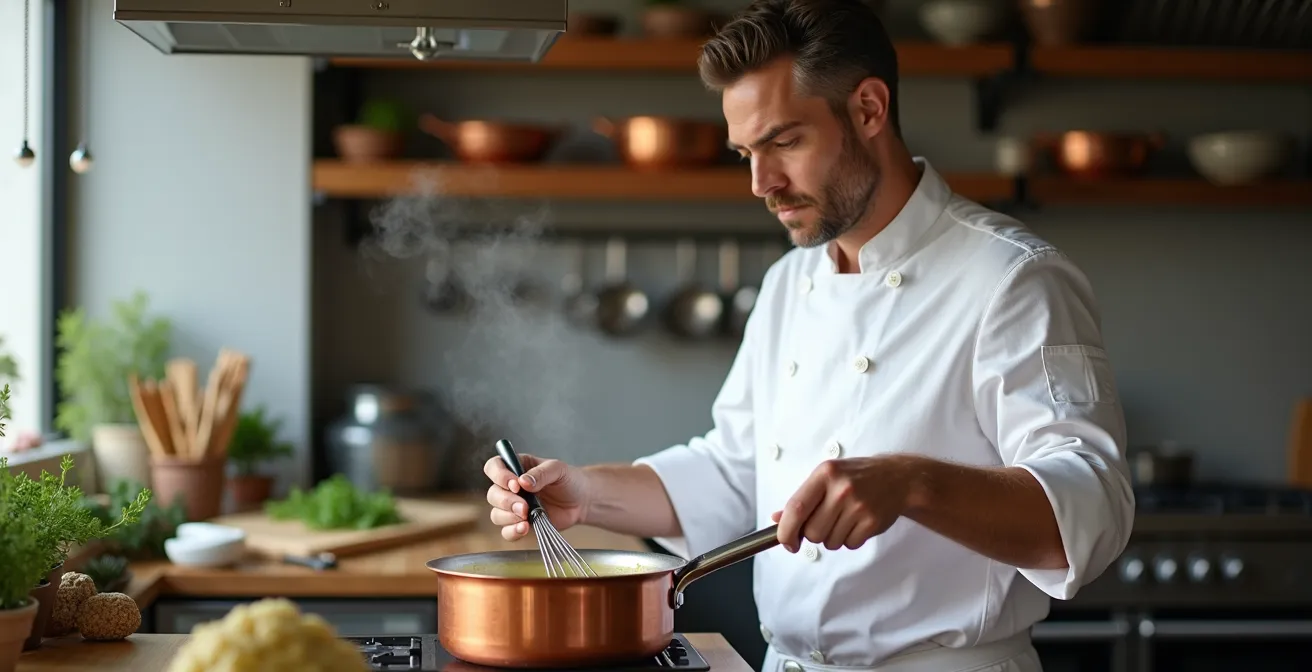
In summary:
- True culinary freedom comes from mastering a chef’s system of thinking, not just memorizing sauce recipes.
- Core techniques like “mise en place,” knife skills, and heat control are the foundational grammar of cooking.
- Understanding professional processes for safety, timing, and preparation transforms cooking from a chore into a creative act.
- Applying these principles allows you to adapt any recipe, invent new dishes, and cook with instinct and confidence.
For any home cook aspiring to move beyond the rigid confines of a recipe, the advice is almost always the same: “Master the five mother sauces.” Béchamel, Velouté, Espagnole, Hollandaise, and Tomate are lauded as the pillars of classical cuisine, the foundation upon which countless dishes are built. The promise is that once you know them, you can cook anything. While there is truth to this, it’s an incomplete picture. Following recipes for these five sauces is no different from following a recipe for any other dish; it doesn’t, in itself, grant you freedom.
The real secret to breaking free from recipe dependency doesn’t lie in the sauces themselves, but in understanding the professional system of thought that makes their creation possible. It’s a holistic approach that encompasses preparation, tool mastery, heat management, and workflow orchestration. The mother sauces are merely a final product of this deeply ingrained system. This guide departs from simply listing recipes. Instead, it deconstructs the core professional techniques that empower a chef to cook with intuition, precision, and consistency. We will explore the “why” behind a chef’s methods, revealing that culinary freedom is not a destination, but a process built on a foundation of solid, interconnected skills.
This article will guide you through the fundamental pillars of this professional system. We will dissect each critical component, from the mental organization of ‘mise en place’ to the scientific precision of modern techniques, providing a clear roadmap to elevate your cooking from rote execution to intentional creation.
Summary: A Chef’s Framework for Culinary Independence
- Why Does “Mise en Place” Reduce Cooking Stress by 50%?
- How to Sharpen Your Chef’s Knife to Razor Edge Using a Whetstone?
- Gas vs Induction: Which Heat Source Do Professional Chocolatiers Prefer?
- The Cutting Board Mistake That Causes “Stomach Flu” in Home Kitchens
- In What Order Should You Cook Dishes to Ensure Everything Is Hot at Service?
- How to Land an Apprenticeship with a Master Craftsman in a Niche Field?
- How to Prep Ingredients (Not Just Meals) to Save 5 Hours a Week?
- How to Apply “Molecular Gastronomy” Techniques at Home Without expensive Gear?
Why Does “Mise en Place” Reduce Cooking Stress by 50%?
The French term “mise en place” translates to “everything in its place.” It is the single most important organizational principle in any professional kitchen. This isn’t just about chopping vegetables before you start cooking; it’s a philosophy of preparation that transforms cooking from a chaotic, reactive scramble into a calm, controlled process. By reading the recipe, gathering all your equipment, and prepping every single ingredient before any heat is applied, you front-load the mental effort. This eliminates the frantic search for a spice or the rush to chop an onion while another ingredient is burning. This methodical approach is the foundation of culinary grammar, allowing a cook to focus on technique and timing rather than logistics.
The cognitive benefit is profound. Research and anecdotal evidence from professional kitchens suggest that proper preparation can lead to a stress reduction of up to 50% during the cooking process. When every component is measured, cut, and arranged in order of use, your brain is freed from multitasking. You execute a series of simple, linear steps instead of juggling multiple complex tasks simultaneously. This is the difference between being a frantic line cook and a composed chef.
Case Study: The Methodology of a 3-Star Michelin Kitchen
Consider the career of Chef Jean-Pierre, who trained at the legendary 3-star Michelin restaurant L’Oustau de Baumanière. In such high-pressure environments, the only way to execute complex dishes with perfect consistency is through an unwavering commitment to mise en place. This system enabled chefs like him to work efficiently and flawlessly in world-renowned kitchens on the French Riviera. For them, mise en place wasn’t a suggestion; it was the unbreakable law of the kitchen that made excellence possible, service after service.
For the home cook, adopting this practice means every recipe becomes less intimidating. It’s the first and most critical step toward breaking recipe dependency, as it forces you to understand the entire scope of a dish before you begin. It builds confidence and turns your kitchen into a serene and efficient workspace.
How to Sharpen Your Chef’s Knife to Razor Edge Using a Whetstone?
If mise en place is the mind of the kitchen, a sharp knife is its soul. A dull knife is not only inefficient but also dangerous; it requires more pressure to cut, increasing the risk of it slipping and causing injury. More importantly, a sharp knife is an instrument of precision. It glides through food without crushing delicate cell walls, which preserves the texture and flavor of your ingredients, from a crisp vegetable to a tender piece of fish. Mastering the art of sharpening with a whetstone is a fundamental skill that connects you directly to your most important tool. It’s a rite of passage that moves you from being a mere user of tools to a true craftsperson.
The process involves using a water stone with varying levels of grit to first reshape a dull edge and then refine it to a razor-sharp finish. It’s a tactile skill that requires patience and consistency. The key is maintaining a constant angle (typically between 15-20 degrees for most chef’s knives) as you slide the blade across the stone. You learn to listen for the change in sound as a “burr”—a tiny fringe of metal—forms along the edge, and to feel for it with your thumb. This sensory feedback is the language of steel, and learning it is essential for any serious cook.
The type of steel your knife is made from will dictate the specific grits you should use. Harder Japanese steel can take a more acute angle and be polished to a finer edge, while softer German steel is more durable and easier to sharpen for daily use.
This table provides a general guide for selecting the right whetstone grit for your knife, an essential piece of knowledge for maintaining your primary culinary tool.
| Steel Type | Initial Repair | Standard Sharpening | Final Polish |
|---|---|---|---|
| Japanese (Hard) | 400-600 grit | 1000-2000 grit | 400-8000 grit |
| German (Soft) | 220-400 grit | 1000 grit | 3000-6000 grit |
| Carbon Steel | 400 grit | 1000-1500 grit | 5000-6000 grit |
Gas vs Induction: Which Heat Source Do Professional Chocolatiers Prefer?
Once your ingredients are prepped and your tools are sharp, the next element of the professional system is heat control. The ability to apply precise, responsive heat is what separates a perfectly seared steak from a grey, overcooked one, or a silky custard from a scrambled mess. The two dominant technologies in modern kitchens are gas and induction. Gas offers a visual, visceral connection to the flame, providing powerful, instantaneous heat that is ideal for tasks like searing and wok cooking. However, it can be difficult to control at very low temperatures and is less energy-efficient.
Induction cooking, on the other hand, uses magnetic fields to directly heat the pan itself. This technology offers unparalleled temperature precision and responsiveness, with almost no wasted energy. For tasks requiring delicate and stable heat, such as tempering chocolate, holding a sauce at a specific temperature, or creating an emulsion like Hollandaise, induction is the clear preference for many professionals, especially chocolatiers. The ability to set a cooktop to an exact degree and have it hold that temperature without fluctuation is a game-changer for consistency. It removes guesswork and allows the chef to focus on the technique at hand.
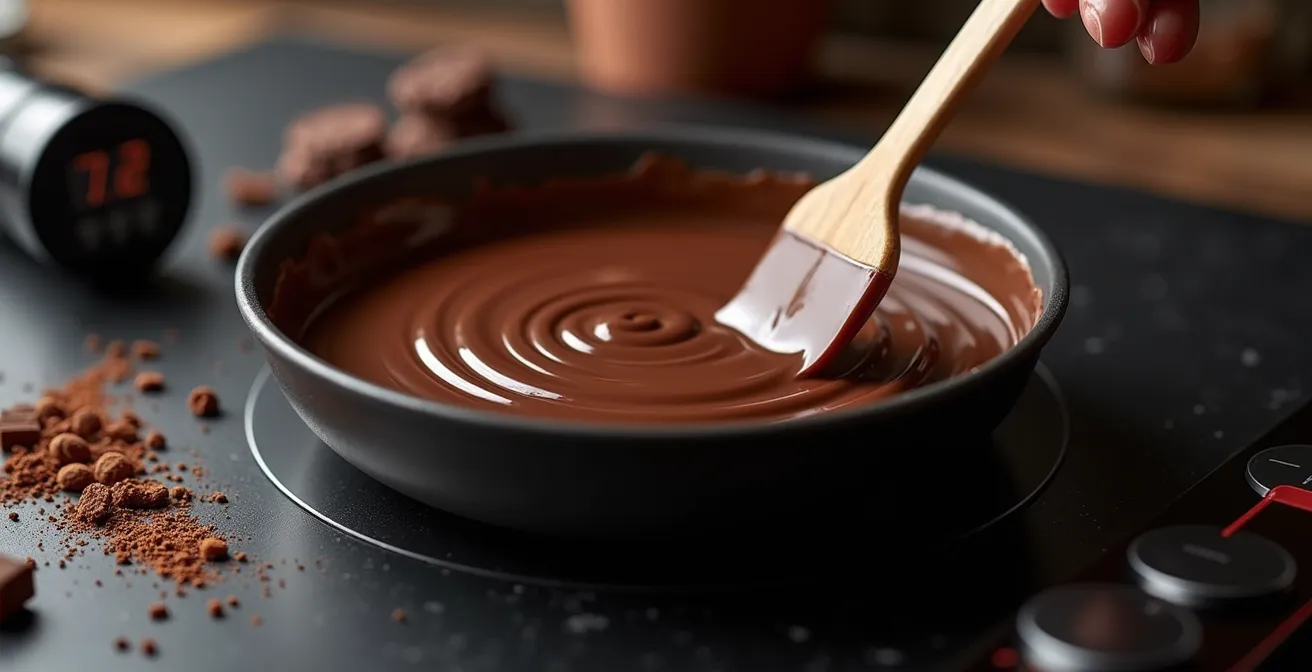
As the image above illustrates, the clean and controlled environment of an induction cooktop is ideal for delicate work. There are no hot spots or open flames to scorch the sensitive chocolate. However, the ultimate professional kitchen often doesn’t choose one over the other. According to a workflow analysis from the Auguste Escoffier School of Culinary Arts, many high-end kitchens employ a hybrid approach to heat management. They use the raw power of gas for high-heat applications like browning bones for an Espagnole sauce, then move to induction for the precise, gentle simmering and emulsification stages. Understanding which heat source to use for which task is a hallmark of a skilled chef.
The Cutting Board Mistake That Causes “Stomach Flu” in Home Kitchens
The professional kitchen system is built on a foundation of unyielding standards, and none is more critical than food safety. A beautiful dish is worthless if it makes someone sick. The most common and dangerous mistake made in home kitchens is cross-contamination, often stemming from improper cutting board use. Using the same board for raw chicken and then for fresh vegetables without proper sanitization is a direct route to foodborne illness. What many people dismiss as a 24-hour “stomach flu” is often a mild case of salmonella or E. coli poisoning originating from their own kitchen.
In fact, according to some food safety analyses, as many as 75% of foodborne illnesses in home kitchens result from this kind of cross-contamination. Professionals mitigate this risk with a strict, non-negotiable system: color-coded cutting boards. This simple visual system removes any ambiguity: red is for raw meat, green for vegetables, yellow for poultry, blue for fish, and white for dairy or ready-to-eat foods. This practice is not optional in a professional setting; it is a fundamental rule of kitchen grammar.
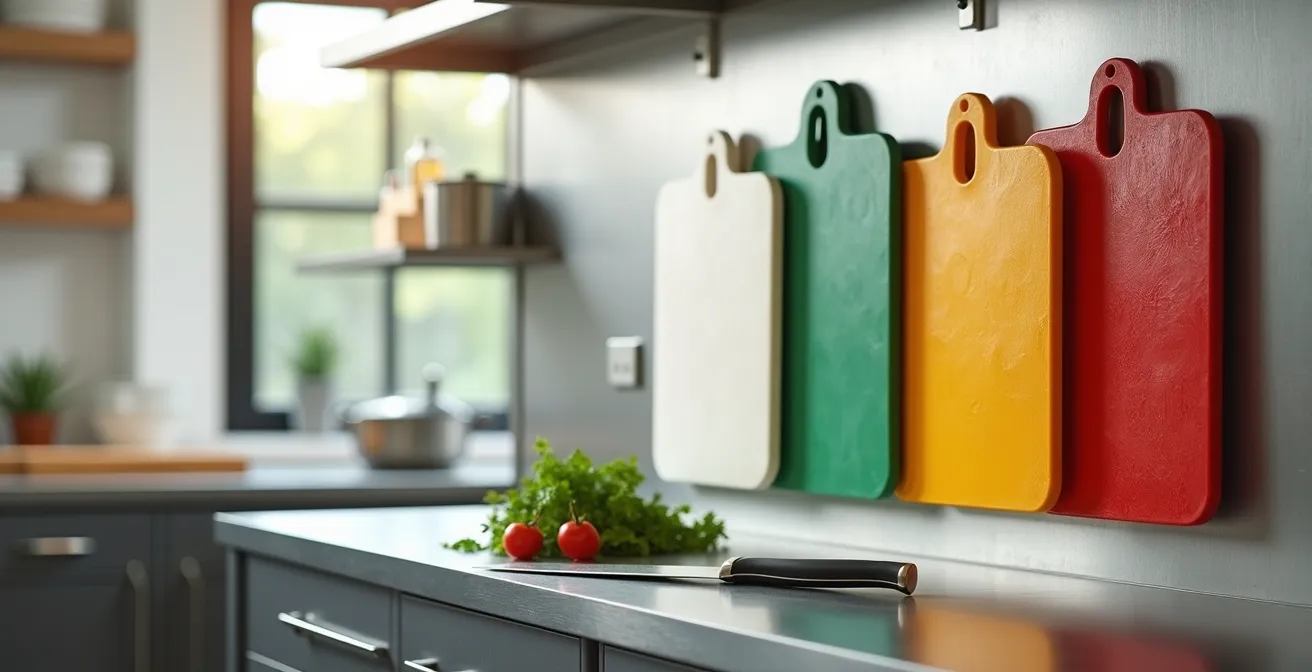
Beyond color-coding, the protocol for board maintenance is equally rigorous. Sanitization after every use and regular deep cleaning are standard. Critically, professional chefs know when to retire a board. Once a cutting board develops deep knife scars and grooves, it becomes impossible to properly sanitize, as bacteria can thrive in these micro-crevices. A heavily scarred board is a liability, not a sign of a well-used kitchen. Adopting this systematic approach to hygiene is a non-negotiable step in thinking and cooking like a professional.
Action Plan: Implementing a Professional Food Safety Protocol
- Dedicate separate boards by color: Red for raw meat, green for vegetables, white for dairy. Never deviate.
- Sanitize boards immediately after use with a solution of 1 tablespoon of bleach per gallon of water, or run them through a high-heat dishwasher.
- Perform a weekly deep clean: Scrub your boards with coarse salt and half a lemon to remove stains and abrade the surface clean.
- Inspect boards monthly for wear. If knife scars are deep enough to catch a fingernail (over 1mm), it’s time to retire the board.
- Establish the golden rule: Never, under any circumstances, place cooked or ready-to-eat food on a surface that has held raw meat without a full sanitization cycle.
In What Order Should You Cook Dishes to Ensure Everything Is Hot at Service?
The final act of the professional kitchen system is orchestration: bringing multiple components together at the perfect time, at the perfect temperature. This is the skill that separates a home cook who serves one hot dish with two lukewarm sides from a chef who presents a fully integrated, perfectly hot plate of food. The secret is not to cook faster, but to plan backward. Professionals call this creating a “reverse timeline.” Instead of starting with what takes longest, you start with the moment of service—the “pass”—and work your way back, scheduling every task.
This method requires you to break down your menu into individual components and categorize them. You need to know the active cooking time, any required resting time (like for a steak or roast), and whether an item can be held at temperature (a ‘Hold’ item) or must be served immediately upon finishing (a ‘Fire’ item). For example, a braised dish can be made hours ahead and held, while a pan-seared scallop must be fired moments before serving. Your reverse timeline starts with the ‘Fire’ items, scheduling them to finish exactly at service time. You then work backward, slotting in the ‘Hold’ items and all the preceding prep work.
This level of planning is exemplified by the classic French ‘brigade’ system. In this system, the sauce station (saucier) must operate on a multi-hour timeline. For instance, an Espagnole sauce may require two hours of simmering, with the pan being changed every 40 minutes to manage the fond. The saucier must coordinate this long process with the grill and vegetable stations so that the sauce, steak, and sides all arrive at the pass simultaneously and perfectly hot. This is workflow choreography, and it’s a skill that can be scaled down to any home-cooked meal, ensuring your efforts result in a cohesive, enjoyable dining experience.
Building this timeline on paper before you even begin cooking removes the stress of in-the-moment decision-making and is the ultimate expression of control in the kitchen.
How to Land an Apprenticeship with a Master Craftsman in a Niche Field?
While self-study and practice are invaluable, the fastest way to internalize the complex, often unwritten rules of the professional kitchen system is to learn directly from a master. An apprenticeship, or “stage” in culinary terms, is an immersive experience where you learn not just techniques, but a way of thinking, moving, and seeing. Landing such an opportunity, especially with a sought-after craftsman, requires more than just enthusiasm; it requires a strategy. You must demonstrate that you are not there to take, but to contribute. This begins with deep, respectful study of the master’s work. You must understand their philosophy, their signature dishes, and their specific techniques before you even make contact.
The next step is to create “proof of work.” Don’t just say you’re passionate; show it. Perfect one of their most challenging recipes and document your process meticulously. This demonstrates your commitment, attention to detail, and genuine respect for their craft. Chef Jean-Pierre’s own journey began this way. He started mastering the complex craft of charcuterie at age twelve, a demonstration of exceptional dedication that eventually earned him an apprenticeship at L’Oustau de Baumanière, a 3-star Michelin institution and one of the world’s best restaurants. He showed his value before he asked for a position.
When you approach a master, don’t ask what they can do for you. Instead, propose what you can do for them. Offer a specific skill: perhaps you can help organize their recipes, document their techniques for a new generation, or manage their social media. You are presenting yourself as a solution to a problem they may have, such as preserving their legacy. A great mentor’s impact is deeply felt by their students, as this comment on one of Chef Jean-Pierre’s masterclasses reveals:
All great chefs are rightly proud of their sauces and your obvious total delight and pride when teaching your ‘versions’ of these classics rates you amongst the world’s best chefs and, arguably, the very best on YouTube. It’s cold and miserable here in London, UK but your personality and enthusiasm lifts even the lowest spirits. I raise a class to you, maestro – long may you reign.
– YouTube Viewer, Comment on Chef Jean-Pierre’s Mother Sauces Masterclass
Finding a mentor who inspires such devotion is the goal. By proving your worth and demonstrating your understanding of kitchen hierarchy and etiquette, you position yourself not as a student, but as a worthy disciple ready to carry the torch.
How to Prep Ingredients (Not Just Meals) to Save 5 Hours a Week?
The concept of “meal prep” is popular, but professionals take it a step further with “component prep.” Instead of cooking entire meals for the week, a chef preps versatile components that can be assembled into numerous different dishes. This is the key to both efficiency and creativity. By spending time on a Sunday preparing a batch of roasted garlic, a quart of mirepoix (diced onion, carrot, and celery), blanched vegetables, and a versatile vinaigrette, you are building a culinary arsenal for the week ahead. This approach is far more flexible than having five identical containers of chicken and broccoli.
This method drastically reduces the “activation energy” required to cook a fresh meal on a busy weeknight. When your onions are already diced and your garlic is already roasted, throwing together a quick sauce or a sauté becomes a 10-minute task, not a 30-minute chore. According to professional chef time-studies, this systematic approach pays huge dividends: 90 minutes of focused component prep on a Sunday can save 30 minutes daily throughout the workweek. That’s a net saving of 2.5 hours, and a significant reduction in daily stress. With prepped components, you are always just minutes away from a home-cooked meal.
The key to successful component prep is understanding the shelf life of different items and the best way to store them. A jar of herb oil will last for weeks, while chopped mirepoix should be used within a few days. Mastering this system allows you to stock your fridge like a professional pantry, ready for anything.
This guide provides a starting point for building your component prep library. With these items on hand, you can pivot to a wide variety of meals with minimal effort.
| Component | Storage Method | Shelf Life | Best Use |
|---|---|---|---|
| Chopped Mirepoix | Airtight container | 5 days | Soups, sauces, braises |
| Blanched Vegetables | Ice bath, then dried | 7 days | Quick sautés, salads |
| Herb Oil | Dark bottle, refrigerated | 2 weeks | Finishing, marinades |
| Roasted Garlic | Covered in oil | 3 weeks | Sauces, spreads |
| Toasted Nuts | Sealed container | 1 month | Garnishes, salads |
Key Takeaways
- System Over Recipes: True culinary mastery is built on an integrated system of techniques, not a collection of individual recipes.
- Process Is Paramount: Focus on the fundamental processes of preparation (mise en place), tool mastery (knife skills), and control (heat, hygiene, timing).
- Cook with Intention: By internalizing these principles, you move from simply following instructions to making intentional, creative decisions in the kitchen.
How to Apply “Molecular Gastronomy” Techniques at Home Without expensive Gear?
The term “molecular gastronomy” can be intimidating, conjuring images of scientists in lab coats with liquid nitrogen and centrifuges. However, at its core, it is simply the application of scientific principles to understand and manipulate the transformations of ingredients during cooking. Many of its foundational techniques do not require expensive equipment and are, in fact, extensions of the classical principles we’ve been discussing. Understanding the “why” behind emulsification, gelation, and the Maillard reaction is the final frontier of the professional system, allowing you to solve problems and innovate with pantry staples.
For instance, creating a stable mayonnaise is a lesson in emulsification, where egg lecithin acts as a bonding agent between oil and water. Creating a light foam or “air” can be done with soy lecithin, a common pantry item for vegan bakers. You can even replicate the effects of a multi-thousand-dollar sous-vide machine with a simple piece of camping equipment. As a testament to this ingenuity, numerous home cooks have achieved perfect sous-vide results using beer coolers as insulated water baths. By filling a cooler with hot water at a target temperature, you can cook a tough cut of meat low and slow for hours, achieving the same tender, evenly-cooked result as a professional setup.
This is the essence of thinking like a modern chef: understanding the scientific principle (low-temperature, long-time cooking) and adapting the method to the tools at hand. It’s about being resourceful and knowledge-driven. Mastering the basic science allows you to control outcomes with precision, whether you’re adjusting the pH of a marinade with baking soda to enhance browning or using agar-agar to create delicate “caviar” pearls from fruit juice. This knowledge is the ultimate freedom from recipes, as it equips you to invent your own techniques.
To truly cook with freedom, you must stop seeing cooking as a list of recipes and start seeing it as the application of this integrated system. Begin by embracing mise en place, and you will find that every other step becomes easier, more intuitive, and ultimately more creative.