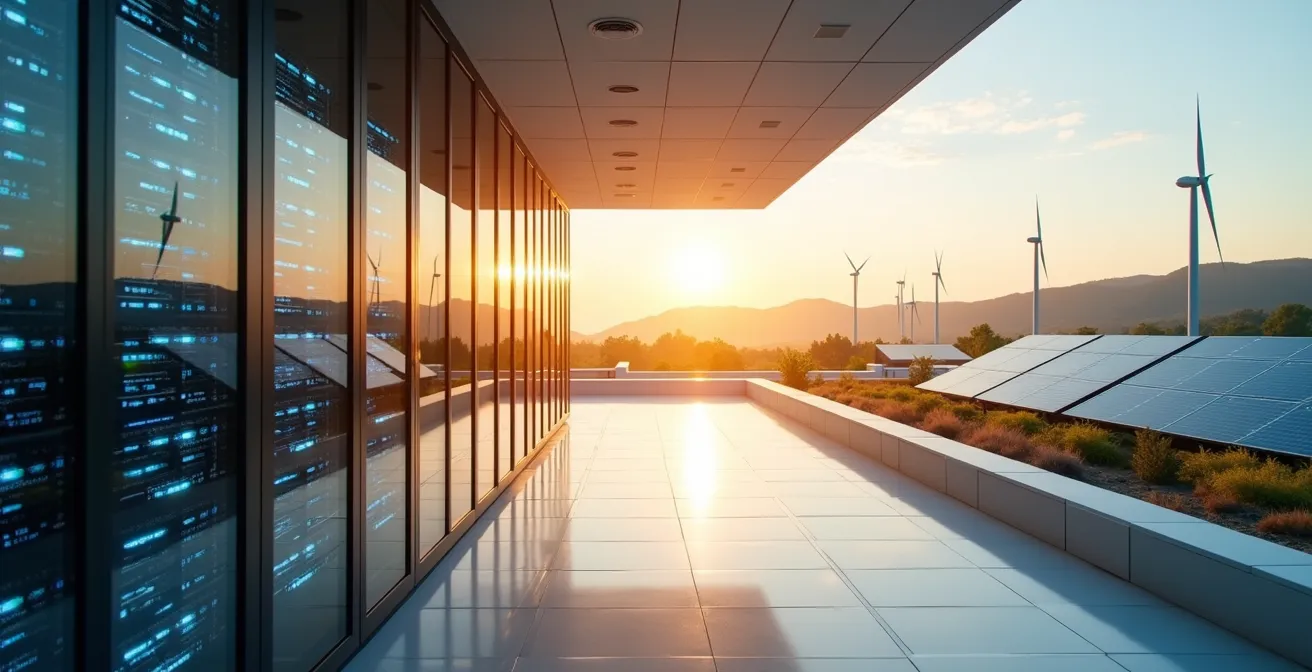
Scaling your business doesn’t have to mean scaling your carbon footprint; a smarter approach decouples growth from environmental impact.
- Sustainable digital transformation is achieved by treating data, code, and hardware as valuable assets within a circular system, not as disposable resources.
- This requires actively rooting out hidden inefficiencies like “dark data” and scrutinizing vendor claims far beyond their “green” marketing labels.
Recommendation: Adopt a “Total Carbon Ownership” (TCO2) model as your primary framework for making truly sustainable procurement and lifecycle decisions.
For today’s Chief Technology Officers and Corporate Social Responsibility Directors, the central challenge is a paradox: how do you drive technological expansion and innovation while simultaneously shrinking your organization’s environmental footprint? The pressure to meet ambitious ESG (Environmental, Social, and Governance) goals is immense, yet the demand for more data, faster applications, and scalable infrastructure has never been higher. This conflict can feel like an impossible balancing act.
Conventional wisdom offers simple, but often superficial, solutions. You’re told to “move to a green cloud provider” or “focus on recycling e-waste.” While these are not bad ideas, they are piecemeal tactics that fail to address the systemic nature of digital unsustainability. They are the equivalent of treating symptoms without diagnosing the underlying disease. The result is often a portfolio of isolated “green gestures” that do little to alter the fundamental trajectory of resource consumption.
But what if the true key to sustainable scaling lies not in what you buy, but in how you design your entire digital ecosystem? The most innovative and ethical approach is to build a Circular Digital Economy within your organization. This framework shifts the perspective from a linear “take-make-dispose” model to a circular one, where every digital asset—from a line of code and a byte of data to a server and a laptop—is managed with an efficiency-first, zero-waste lifecycle. It’s about re-architecting the system, not just greening its edges.
This guide provides a strategic roadmap for implementing this circular approach. We will explore the hidden energy sinks in your infrastructure, dissect the claims of vendors, and provide actionable frameworks for making decisions that are both technologically sound and environmentally responsible. It’s time to move beyond the platitudes and build a digital infrastructure that is resilient, efficient, and genuinely sustainable.
Summary: How to Scale Your Digital Infrastructure While Reducing Your Carbon Footprint?
- Why Does Storing “Dark Data” Consume More Energy Than Bitcoin Mining?
- How to Code a Website That Uses 40% Less Energy on Client Devices?
- Refurbished vs New Laptops: Which Choice Makes Sense for a Sustainable Fleet?
- The “Green” Label Trap: How to Spot Fake Sustainability Claims from Tech Vendors?
- When to Replace Hardware: The Optimal Cycle to Minimize E-Waste
- How to Reduce Data Center Energy Costs by 25% with Intelligent Cooling?
- In What Order Should You Upgrade Appliances to Maximize Energy Savings?
- How to Implement Zero-Waste Practices in Hospitality Without Sacrificing Luxury?
Why Does Storing “Dark Data” Consume More Energy Than Bitcoin Mining?
The term “dark data” refers to all the digital information an organization collects, processes, and stores during regular business activities but fails to use for any other purpose. It’s the vast ocean of ROT: Redundant, Obsolete, and Trivial data lurking in your servers. While the energy consumption of Bitcoin mining captures headlines, the silent, pervasive cost of dark data is arguably a greater threat to corporate sustainability goals. The issue isn’t intensity, but scale. Bitcoin’s energy use is concentrated; dark data is a low-level, continuous drain across millions of servers globally.
The reason for this immense consumption is simple: every byte, useful or not, resides on a physical server that requires constant power and cooling. When you consider that cloud data centers consume more than 2.4% of electricity worldwide, it becomes clear that storing petabytes of useless information is an egregious waste. This is where a principle of Data Thermodynamics becomes essential. Just as in physics, energy should only be expended where it creates value. Data must be classified by its “temperature”:
- Hot Data: Frequently accessed and critical. Kept on high-performance, high-energy storage.
- Warm Data: Accessed periodically. Migrated to standard, more energy-efficient storage.
- Cold Data: Accessed rarely, for archival or compliance reasons. Moved to low-power archive tiers.
- Frozen Data: Retained for legal reasons but almost never accessed. Stored on ultra-low-power tape or archived and taken offline.
By systematically identifying and either deleting ROT data or moving it to appropriate, lower-energy storage tiers, organizations can dramatically reduce the passive energy drain from their infrastructure. This isn’t just a cleanup exercise; it’s a fundamental principle of a circular digital economy: stop paying to power forgotten information.
How to Code a Website That Uses 40% Less Energy on Client Devices?
Digital sustainability extends beyond the data center; it reaches all the way to the client devices—the laptops, tablets, and smartphones—that access your services. Inefficiently coded websites and applications force these devices to work harder, consuming more battery power and contributing to a larger collective carbon footprint. This is a critical and often overlooked aspect of Corporate Social Responsibility. The design of your digital products directly impacts the energy consumption of your user base.
A primary culprit is the unoptimized delivery of rich media. According to IEA analysis, video streaming accounts for a staggering 75% of global data traffic. An auto-playing, high-resolution video banner on your homepage might look good, but it’s an energy hog. Adopting a Carbon-Aware Architecture for web development means making energy efficiency a key performance indicator, alongside loading speed and user experience. It involves a conscious effort to send fewer bytes and demand less processing power from the end-user’s device.

As the visualization shows, the difference between a bloated, energy-intensive site and an optimized one is stark. The goal is to create a lightweight, efficient data flow. Implementing this requires a shift in development priorities and a focus on practical, carbon-reducing techniques.
Action Plan: Your Carbon-Aware UX Design Checklist
- Implement lazy-loading for all images, videos, and JavaScript components so they are only loaded when they enter the viewport.
- Use system fonts (like Arial, Times New Roman) instead of custom web fonts to eliminate an entire category of file downloads.
- Enable a “low-carbon mode” option for users, which disables non-essential animations, auto-playing videos, and high-resolution images.
- Compress all images to modern formats like WebP or AVIF, which can achieve up to a 50% size reduction over traditional JPEG/PNG with similar quality.
- Defer the loading of non-critical JavaScript (like analytics or chat widgets) until after the main page content is fully rendered and interactive.
Refurbished vs New Laptops: Which Choice Makes Sense for a Sustainable Fleet?
When it comes to managing an enterprise’s device fleet, the procurement decision between new and refurbished hardware is a critical leverage point for sustainability. The traditional IT mindset often defaults to “new is better,” prioritizing the latest models and longest warranties. However, a circular economy perspective forces a more nuanced analysis that extends beyond purchase price and performance specs. It requires calculating the Total Carbon Ownership (TCO2), a metric that accounts for the carbon emissions generated throughout the device’s entire lifecycle.
The most significant insight from a TCO2 analysis is that the vast majority of a laptop’s lifetime carbon footprint is embedded in its manufacturing. The extraction of raw materials, fabrication of components like microchips and batteries, and global assembly processes are incredibly energy-intensive. By choosing a high-quality refurbished device, you are effectively sidestepping this entire manufacturing carbon cost, as the device has already been produced. This single decision can have a massive impact on your organization’s Scope 3 emissions.
The following table, based on data from sustainability analyses, provides a clear comparison. As a recent comparative analysis shows, the carbon savings are undeniable, even when accounting for a slightly shorter lifespan and potentially higher energy use of an older model.
| Factor | New Laptop | Refurbished Laptop |
|---|---|---|
| Manufacturing Carbon | 300-400 kg CO2e | 0 kg CO2e (already manufactured) |
| Annual Energy Use | 20-30 kg CO2e | 25-35 kg CO2e |
| Expected Lifespan | 5-6 years | 3-4 years |
| Total 5-Year Carbon | 400-550 kg CO2e | 75-140 kg CO2e |
The data makes a compelling case. For many corporate roles, a professionally refurbished laptop offers more than sufficient performance while generating a fraction of the carbon emissions. A blended fleet strategy, where high-performance users receive new machines and standard users receive high-grade refurbished ones, is a pragmatic and highly effective pillar of a circular digital economy.
The “Green” Label Trap: How to Spot Fake Sustainability Claims from Tech Vendors?
As sustainability becomes a top corporate priority, technology vendors are increasingly wrapping their products and services in “green” marketing. This has led to a surge in greenwashing—the practice of making misleading or unsubstantiated claims about the environmental benefits of a product. For CTOs and CSR leaders, falling into this “green label trap” is a significant risk. It can lead to poor investment decisions, reputational damage, and a failure to meet real ESG targets. True digital sustainability requires rigorous due diligence, not blind trust in marketing slogans.
The key is to move beyond vague adjectives like “eco-friendly,” “sustainable,” or “green” and demand hard, quantifiable metrics. As one Invenia Tech Green Data Centers Analysis notes, accountability is paramount.
Clients and shareholders are increasingly asking for sustainability transparency.
– Industry Report, Invenia Tech Green Data Centers Analysis
This demand for transparency must be embedded directly into your procurement process. Your Request for Proposals (RFPs) should function as a greenwashing filter, forcing vendors to substantiate their claims with verifiable data. Scrutinizing certifications and demanding proof is not cynicism; it’s responsible governance.

To avoid being misled, arm your procurement team with a checklist of probing questions that cut through the marketing fluff. Instead of accepting claims at face value, require evidence for each one. Key areas to investigate include:
- Energy Efficiency: Demand specific Power Usage Effectiveness (PUE) metrics for data centers, not just generic “efficient” claims. A PUE of 1.2 is excellent; a PUE of 1.8 is not.
- Water Consumption: Ask for Water Usage Effectiveness (WUE) measurements, especially for data centers in water-stressed regions.
- Renewable Energy: Verify renewable energy claims by asking for third-party validated certificates or direct Power Purchase Agreements (PPAs).
- Hardware Lifecycle: Require vendors to provide Life Cycle Assessment (LCA) reports for their hardware, detailing the carbon footprint from manufacturing to end-of-life.
- Commitments: Look for time-bound, quantifiable emission reduction targets (e.g., “reduce Scope 2 emissions by 50% by 2030”) rather than vague promises to “become greener.”
When to Replace Hardware: The Optimal Cycle to Minimize E-Waste
The traditional three-to-four-year hardware refresh cycle, once the gold standard of IT management, is becoming an outdated and wasteful practice. This rigid, one-size-fits-all approach generates massive amounts of e-waste and ignores the significant embedded carbon in every new device manufactured. With McKinsey research showing enterprise technology producing 350 to 400 megatons of CO2e annually, rethinking the hardware lifecycle is no longer optional; it’s a strategic imperative for any organization serious about its ESG commitments.
The optimal replacement cycle is not a fixed number of years. Instead, it should be a fluid, needs-based strategy that maximizes the useful life of every asset. The goal of a circular economy is to keep products and materials in use for as long as possible. This means breaking free from arbitrary refresh schedules and adopting a more intelligent, tiered approach to hardware deployment and retirement. A device that is no longer suitable for a power user may be perfectly adequate for another role within the organization, or for a secondary purpose like digital signage.
This philosophy is best exemplified by the “cascading lifecycle” model. Instead of disposing of a three-year-old laptop, it is cascaded down the organization, extending its useful life and dramatically reducing the demand for new hardware and the volume of e-waste generated.
Case Study: The Cascading Lifecycle Policy
Organizations that implement a formal cascading lifecycle policy for their hardware report a 30-40% reduction in e-waste and associated procurement costs. The model is simple yet effective: high-performance users (e.g., developers, data scientists) receive new, powerful equipment. After 2-3 years, their devices are refurbished and “cascaded” to standard business users (e.g., sales, HR), whose performance needs are less demanding. After another 2-3 years in that role, these now 5-6 year-old devices can be repurposed for single-use applications like conference room displays or check-in kiosks, or donated to schools and non-profits, maximizing their total lifespan to 7 years or more before responsible recycling.
Implementing such a policy requires more sophisticated asset management but pays enormous dividends in both carbon reduction and financial savings. It transforms hardware from a disposable commodity into a durable asset managed for maximum value and minimum waste.
How to Reduce Data Center Energy Costs by 25% with Intelligent Cooling?
For any organization with a significant on-premise or co-located data center presence, the single largest operational expenditure and source of energy consumption is often cooling. Servers generate immense heat, and traditional cooling systems operate on a brute-force principle: blast cold air constantly to prevent overheating. This approach is not only inefficient and expensive but also environmentally irresponsible. It’s like leaving the air conditioning on full blast in an empty house. The future of sustainable data center management lies in intelligent, adaptive cooling systems that deliver the right amount of cooling, in the right place, at the right time.
Achieving a 25% or greater reduction in cooling-related energy costs is not a futuristic dream; it’s a tangible goal achievable with today’s technology. The strategy involves moving from a reactive, static cooling model to a proactive, dynamic one. This is accomplished by deploying a network of sensors and using AI/ML algorithms to predict and respond to changing thermal loads in real-time. Instead of cooling an entire room to the temperature required by the hottest server rack, intelligent systems create micro-climates, directing cooling resources precisely where they are needed.
As highlighted by innovators like Tech Mahindra, a comprehensive approach combines physical infrastructure management with data-driven analytics. This ensures that cooling operations are optimized based on server demand, time of day, and real-time thermal mapping. The key implementation steps include:
- Deploying an IoT Sensor Mesh: Install a dense grid of temperature and humidity sensors throughout the data center to create a real-time thermal map.
- Implementing AI/ML for Prediction: Use machine learning algorithms to analyze historical data and predict the formation of hotspots, allowing the system to proactively adjust cooling before a thermal issue occurs.
- Establishing Strict Aisle Containment: Use physical barriers (hot/cold aisle containment) and blanking panels to prevent hot exhaust air from mixing with cold intake air, dramatically improving cooling efficiency.
- Integrating Cooling-Aware Workload Scheduling: Use tools like Kubernetes to automatically schedule high-intensity computing tasks in the coolest available zones of the data center.
- Considering Liquid Cooling: For hyper-dense compute racks, direct-to-chip or immersion liquid cooling offers an order-of-magnitude improvement in efficiency over traditional air cooling.
By adopting these intelligent cooling strategies, organizations can make one of the single most impactful changes to reduce their digital infrastructure’s energy consumption and operational costs.
In What Order Should You Upgrade Appliances to Maximize Energy Savings?
When faced with a limited budget for green IT initiatives, the critical question becomes: where do you start? Upgrading every piece of infrastructure at once is rarely feasible. Therefore, a strategic prioritization framework is essential to ensure that every dollar invested yields the maximum possible carbon reduction and energy savings. The most effective approach is to prioritize upgrades based on a “Carbon ROI,” focusing on the infrastructure with the highest energy consumption and longest operating hours first.
It’s a common mistake to start with highly visible but low-impact items, like client devices. While upgrading laptops is important, the energy savings are minimal compared to the potential gains in the data center core. The backbone of your digital infrastructure—the core network switches, storage arrays, and high-utilization servers that run 24/7/365—represents the largest and most constant source of energy consumption. These are your Priority 1 targets. An older, inefficient core switch running continuously consumes far more power over a year than a fleet of new, energy-efficient laptops used only 8 hours a day.
This prioritization framework helps guide investment decisions away from purely political or visible projects toward those with the greatest environmental and financial impact. The table below provides a clear, data-driven hierarchy for planning your upgrade cycle.
| Priority Level | Target Infrastructure | Annual Operating Hours | Potential Savings |
|---|---|---|---|
| Priority 1 | 24/7/365 Infrastructure (Core Network, Storage) | 8,760 hours | 30-40% |
| Priority 2 | High-Utilization Servers | 6,000+ hours | 20-25% |
| Priority 3 | Variable-Load Servers | 2,000-6,000 hours | 10-15% |
| Priority 4 | Client Devices | 2,000 hours | 5-10% |
By following this logical order, you ensure that your initial investments tackle the biggest sources of energy waste. This creates a virtuous cycle: the significant operational savings realized from Priority 1 upgrades can then help fund the subsequent phases of your green IT roadmap, making the entire sustainability program more self-sufficient.
Key Takeaways
- Embrace a “Circular Digital Economy”: Shift from a linear “take-make-dispose” model to a circular one where data, code, and hardware are managed as durable assets to maximize their lifecycle and minimize waste.
- Measure What Matters: Move beyond vague green labels and demand hard, verifiable metrics like Power Usage Effectiveness (PUE), Water Usage Effectiveness (WUE), and Total Carbon Ownership (TCO2) to make genuinely informed decisions.
- Eliminate Hidden Waste: Actively hunt for and eradicate digital waste, from “dark data” consuming power on servers to “zombie servers” and “orphaned cloud instances” running without purpose.
How to Implement Zero-Waste Practices in Hospitality Without Sacrificing Luxury?
While the title references hospitality, the principle of implementing “zero-waste” practices without sacrificing quality is directly applicable to the world of digital infrastructure. In a corporate context, “luxury” is equivalent to performance, reliability, and scalability. The challenge is to eliminate digital waste—inefficient, redundant, and abandoned resources—without compromising these core operational requirements. This is the final, crucial element of a circular digital economy: applying a zero-waste philosophy to your intangible, virtual assets.
Digital waste is just as real as physical waste, and it carries a significant carbon cost. “Zombie servers” (physical machines running but serving no purpose), “orphaned volumes” (cloud storage blocks not attached to any active instance), and redundant codebases are all forms of digital landfill. They consume energy, occupy expensive storage, and create security vulnerabilities, all while providing zero business value. A digital zero-waste initiative is a systematic hunt to identify and eliminate these resources.
The goal is to create a culture of digital minimalism and resource intentionality. This involves not only cleaning up past mistakes but also implementing frameworks to prevent future waste. Just as a luxury hotel accounts for every linen and piece of silverware, a high-performance IT organization must account for every virtual machine, storage bucket, and IP address. The key practices for this digital clean-up include:
- Identifying “Zombie” and “Comatose” Servers: Use monitoring tools to find servers with zero traffic or CPU utilization over an extended period and decommission them.
- Hunting for Orphaned Cloud Resources: Regularly scan cloud accounts for unattached storage volumes, unused elastic IPs, and old machine snapshots that are incurring charges without providing value.
- Implementing Resource-as-a-Service: Create an internal service model where teams are allocated resources with clear carbon and financial budgets, fostering accountability.
- Creating Reuse Repositories: Establish central libraries for code, services, and virtual machine templates to prevent teams from constantly reinventing the wheel and creating redundant infrastructure.
- Applying Circular Principles to Virtual Machines: Instead of creating new VM templates from scratch, establish a “golden template” that is continuously updated and reused, ensuring consistency and efficiency.
By embracing these digital zero-waste practices, you can streamline operations, reduce costs, lower your carbon footprint, and improve your security posture—all without sacrificing the performance and reliability that your business depends on.
To begin building your circular digital economy, the next logical step is to conduct a “dark data” audit to identify ROT (Redundant, Obsolete, Trivial) information and establish a baseline for your Total Carbon Ownership (TCO2) across your hardware fleet.