True resort privacy is not a feature you buy from a brochure; it is a systemic outcome you verify through operational intelligence.
- Architectural analysis and villa placement are more critical than a “secluded” location.
- A resort’s business model (pay-per-service vs. all-inclusive) directly impacts service discretion and quality.
- Pre-arrival due diligence, especially for new properties, is the only way to mitigate the risk of a compromised experience.
Recommendation: Shift your mindset from a passive guest to a pre-travel intelligence analyst to guarantee the seclusion you command.
The promise is always the same: a secluded villa, a private pool, an escape from the world. Yet, the reality is often a series of subtle intrusions. The murmur of voices from the “private” terrace next door, the unexpected appearance of housekeeping, the distant thrum of a beach party. For the discerning individual, privacy is not an amenity; it is the entire point of the exercise. Ostentatious displays of wealth, like the proverbial gold taps, are a distraction from what truly constitutes luxury: absolute, uninterrupted tranquility.
The conventional wisdom advises looking for features—private pools, adults-only policies, remote locations. This is surface-level thinking. These are merely table stakes. They do not guarantee the absence of visual, acoustic, or service-related infringements on your solitude. The modern high-net-worth traveler understands that marketing materials are designed to sell a fantasy, often glossing over the operational realities that define the guest experience.
But what if the real markers of privacy were invisible to the casual observer? What if they were encoded in a resort’s operational DNA—its architectural layout, its staff-to-guest ratios, its service philosophy, and even its financial model? The key is not to trust, but to verify. It requires a shift in approach: from a passive consumer of luxury to an active analyst performing pre-travel due diligence. It’s about asking the right, often uncomfortable, questions before you even consider booking.
This guide provides the framework for that analysis. We will deconstruct the elements of genuine privacy, moving beyond the brochure to give you the tools to vet a property with the precision of a seasoned fixer. You will learn to identify structural weaknesses, assess service models, and mitigate the risks that can turn a six-figure vacation into a profound disappointment.
To navigate this complex landscape, we have structured this analysis to address the critical questions that truly define resort exclusivity. This framework will guide you through the essential checkpoints for vetting a property’s commitment to privacy, from its physical design to its service culture.
Summary: A Framework for Vetting True Resort Privacy
- Why a 3:Why Maintaining Curiosity Is the #1 Skill to Survive the AI Revolution?
- How to Secure the Best Villa Number Before You Even Arrive at the Resort?
- Ultra All-Inclusive vs Pay-Per-Service: Which Model Ensures Better Food Quality?
- The “Soft Opening” Risk: Why Booking a New Resort Can Ruin Your Vacation?
- When to Book Luxury Resorts to Avoid School Holiday Crowds Completely?
- The “Glass Box” Mistake: Why Visual Walls Don’t Stop Meeting Confidentiality Leaks?
- Individually Plated vs Family Style: Which Is Easier for a Solo Home Chef?
- How to Design a 7-Course Tasting Menu at Home Without Hiring a Staff?
Why a 3:Why Maintaining Curiosity Is the #1 Skill to Survive the AI Revolution?
In the context of luxury travel, the “AI Revolution” is a metaphor for the sophisticated marketing machinery that crafts flawless, often misleading, digital narratives. Resorts use stunning, algorithmically-optimized imagery and testimonials to project an ideal of perfect privacy. Your defense against this is not technology, but a deeply human trait: intellectual curiosity. It is the drive to question the polished surface, to look for the data behind the dream, and to challenge the assumptions presented as fact. It means refusing to be a passive recipient of information.
This intellectual rigor is more critical than ever, as the very definition of luxury escape is shifting. It’s no longer just about opulence; it’s about disconnection. A 2024 McKinsey survey revealed that luxury travelers are two to three times more likely than mass travelers to cite disconnecting from digital devices as a primary reason for travel. This intense desire for a true retreat raises the stakes. When a resort fails to deliver on its promise of seclusion, it’s not a minor inconvenience; it’s a fundamental breach of the core value proposition.
Therefore, curiosity becomes your primary vetting tool. It compels you to ask: “What aren’t they showing me?” It pushes you to investigate the resort’s layout on Google Earth, not just its curated gallery. It leads you to inquire about staff training protocols for discretion, not just the list of available amenities. This is not cynicism; it is strategic diligence. In an era where any image can be perfected, the skill of maintaining a skeptical and inquisitive mindset is what separates a satisfactory trip from a truly private and restorative experience.
How to Secure the Best Villa Number Before You Even Arrive at the Resort?
Securing the right villa is not a matter of luck; it is a function of pre-arrival architectural intelligence. The “best” villa is not necessarily the most expensive, but the one whose specific location and design offer the highest degree of verifiable privacy. Your task is to analyze the resort’s physical blueprint to identify these sanctuaries and then to proactively request a specific unit, by number, during the booking process. This immediately signals to the resort that you are a discerning client with specific expectations.
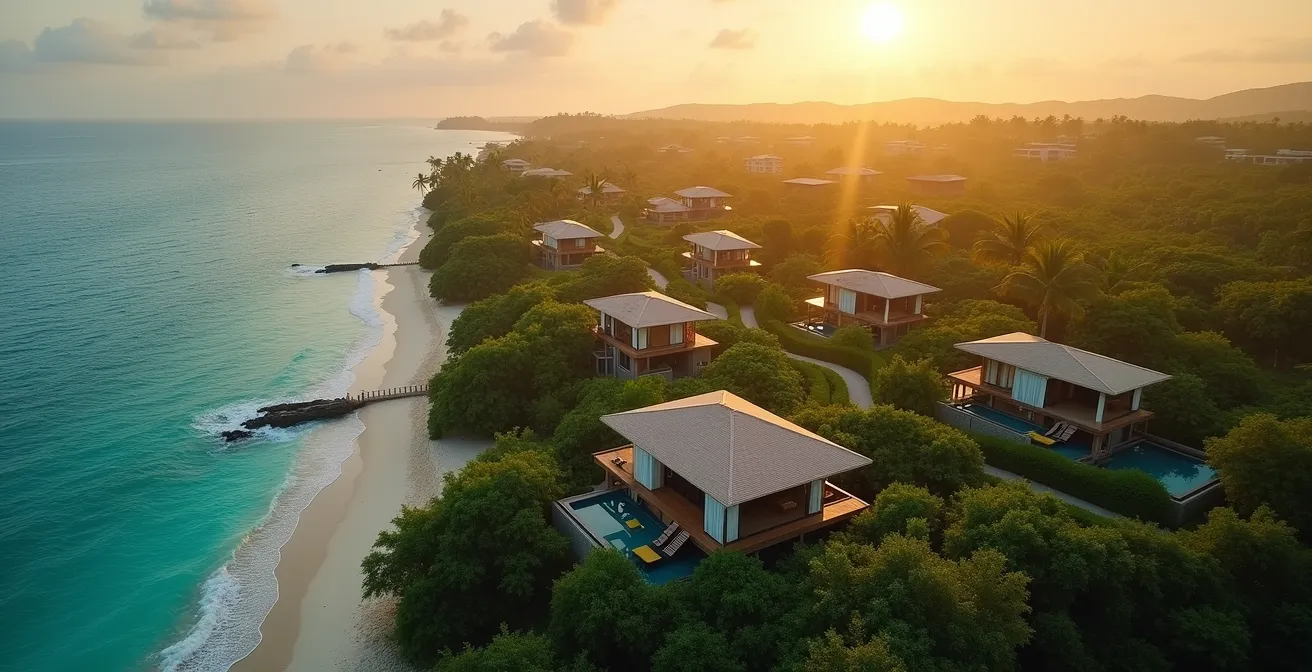
Begin by moving beyond the resort’s stylized property map. Use satellite imagery tools like Google Earth to conduct an objective analysis. Look for staggered villa layouts rather than neat, parallel rows which often create direct lines of sight. Assess natural barriers—not just thin hedges, but significant changes in elevation, rock formations, or dense, mature jungle. Pay close attention to the proximity to service roads, staff quarters, and public areas like restaurants or beach clubs, which are major sources of acoustic and visual disturbance.

The type of villa is a primary determinant of its privacy potential, with market trends reflecting this demand. Overwater villas often provide the greatest seclusion due to their isolation and boat-only access, while hillside locations can use elevation to their advantage. The key is to understand the trade-offs of each.
A comparative analysis shows clear distinctions in privacy levels and features across different villa categories. This data, sourced from market intelligence, can guide your initial selection process before you drill down to a specific unit number.
| Villa Type | Privacy Level | 2024 Market Share | Key Features |
|---|---|---|---|
| Overwater Villas | Maximum | 28% | 360° water views, boat-only access |
| Hillside Villas | Very High | 35% | Elevation advantage, natural barriers |
| Garden Villas | Moderate | 37% | Vegetation screening, ground access |
Case Study: Soneva Secret Maldives’ Architectural Excellence
Soneva Secret in the Maldives is a masterclass in this philosophy. With only 14 villas, some of which are Crusoe Villas accessible only by boat, the resort’s very design engineers seclusion. Each villa is assigned a dedicated team, including a private chef, ensuring service is consolidated and minimally intrusive. This high staff-to-guest ratio and focus on architectural isolation demonstrates a systemic commitment to privacy, making villa selection less about avoiding “bad” units and more about choosing a specific flavor of perfect seclusion.
Ultra All-Inclusive vs Pay-Per-Service: Which Model Ensures Better Food Quality?
While seemingly a question of culinary preference, the choice between an all-inclusive and a pay-per-service (à la carte) model is a powerful indicator of a resort’s entire service philosophy and, by extension, its respect for guest privacy. The financial incentive structure of each model has profound downstream effects on staff caliber, food quality, and the nature of the dining experience itself. For the client who values discretion, the à la carte model is almost always superior.
Ultra all-inclusive resorts operate on a model of volume and predictability. Their kitchens are engineered for mass production, even at a high-end level. This can lead to a standardized, less personalized experience. More importantly, it often fosters a service culture of constant presence and upselling of “premium” options not included in the package. Conversely, a pay-per-service model creates a direct and potent incentive for excellence. As industry experts note, each dish must justify its price, which attracts higher-caliber culinary talent focused on quality over quantity.
This insight is why sophisticated travelers increasingly book directly. Indeed, research from Grand View Research reveals that 42% of luxury hotel bookings in 2024 were made directly with hotels. This allows them to engage with the concierge or management to ask pointed questions about the dining program. Inquire about the executive chef’s background and the sourcing of ingredients. A resort proud of its pay-per-service offerings will have compelling answers. Their model depends on it. This focus on individual excellence often translates into a more discreet and respectful service style across the property, as the culture is one of bespoke delivery rather than mass fulfillment.
The “Soft Opening” Risk: Why Booking a New Resort Can Ruin Your Vacation?
The allure of a brand-new resort is potent: pristine facilities, grand opening offers, and the cachet of being among the first to experience it. However, this is one of the single greatest gambles in luxury travel. A “soft opening” phase is often a chaotic reality of incomplete construction, untrained staff, and non-operational facilities, all hidden behind a façade of slick marketing. For the traveler seeking seamless privacy, booking a resort within its first six months of operation is an unacceptable risk without rigorous verification.
The issues are systemic. Landscaping is often immature, offering little to no visual privacy. Staff, new to their roles and the property itself, have not yet synchronized into the discreet, efficient ballet that defines true luxury service. F&B outlets may be partially open, and promised amenities like a full-service spa might be replaced by a temporary “pop-up” solution. This was seen even in high-profile launches like the Four Seasons Resort Mallorca at Formentor, which opened with a temporary spa facility while the main spa was still under construction for a 2025 debut—a well-managed example, but one that underscores the reality of phased openings.
The result is a constant stream of potential intrusions: the sound of a drill, the sight of contractors, and service that is reactive rather than anticipatory. The promise of tranquility is replaced by the stress of being a beta tester for a multi-million dollar operation. To mitigate this, one must move from trust to forensic inquiry, demanding specific, real-time proof of the resort’s operational status.
Your Pre-Booking Due Diligence Checklist: New Properties
- Demand a real-time, date-stamped video walkthrough of your specific villa and its immediate surroundings, not a promotional reel.
- Ask for the exact operational percentage of all advertised restaurants, bars, and wellness facilities.
- Inquire about the completion date of all landscaping and when the flora was physically planted to assess maturity.
- Verify how many consecutive weeks the property has been operating at or near full capacity to gauge staff experience.
- Request to be put in contact with a guest who stayed within the first month of opening for an unvarnished reference.
When to Book Luxury Resorts to Avoid School Holiday Crowds Completely?
Avoiding crowds is a fundamental component of securing privacy, and timing is your most powerful lever. The common advice to simply avoid major international school holidays (Christmas, Easter, summer) is a starting point, but it’s insufficient for guaranteeing true solitude. A more sophisticated approach requires a multi-layered analysis of both global and, crucially, local holiday schedules.
The most serene and private experiences are found in the “shoulder seasons”—the weeks immediately preceding or following a peak period. During these times, the weather is often still excellent, the full staff is on-site, but occupancy plummets. This creates a rare window where you experience the resort at its best, but feel as though you have it to yourself. The key is micro-scheduling. For a Caribbean resort, don’t just avoid US and European holidays; research the timing of major Canadian holidays like March Break, which can flood resorts unexpectedly.

For the ultimate in privacy, however, one must think beyond simply avoiding others and consider eliminating their presence entirely. A full or partial resort buyout is the apex of this strategy. While a significant investment, it is the only method that provides absolute control over the environment. For a milestone celebration or a high-security retreat, this moves from an extravagance to a logistical necessity. Many elite properties that do not publicly advertise this option are willing to negotiate buyouts during deep shoulder seasons, as it provides them with guaranteed revenue during a slow period.
By layering an understanding of global travel flows, local holiday calendars, and the strategic use of shoulder seasons, you can surgically select a time window that maximizes your solitude. This transforms the calendar from a constraint into a strategic tool for crafting a truly private escape.
The “Glass Box” Mistake: Why Visual Walls Don’t Stop Meeting Confidentiality Leaks?
The “Glass Box” mistake is a critical flaw in modern resort design, and a trap for the unwary traveler. It refers to a villa or suite that boasts floor-to-ceiling glass walls to maximize views, creating a stunning visual experience that is, in fact, an acoustic and digital sieve. While originally a term for corporate meeting spaces where visual privacy was mistaken for confidentiality, it perfectly describes the fallacy of many luxury accommodations. You may not be able to see your neighbors, but can they hear you? And more importantly, who else is listening?
True privacy is multi-sensory. Acoustic privacy is as important as visual privacy. A conversation on your terrace should not be audible from the next. Before booking, inquire directly about soundproofing specifications. Ask about the materials used in partition walls (are they solid concrete or simple drywall?) and request acoustic STC (Sound Transmission Class) ratings if available. A high-end resort serious about privacy will have this data.
Furthermore, the Glass Box mistake extends to the digital realm. A physically secure villa is meaningless if your digital communications are exposed. As a case study on digital vulnerabilities in luxury resorts highlights, property-wide Wi-Fi networks are notoriously insecure, and in-room smart devices can be compromised. For any sensitive conversation, the only safe assumption is that the digital environment is hostile. True privacy requires using a personal VPN for all internet traffic and physically disconnecting or powering down all in-room IoT devices (smart speakers, tablets) for the duration of your stay.
To avoid the Glass Box, your due diligence must include a specific checklist:
- Analyze density maps and satellite views for a minimum of 50-meter spacing between villa structures.
- Look for staggered or angled villa layouts on property maps, which are superior to straight, parallel rows.
- Request specific soundproofing specifications and acoustic ratings for partition walls and windows.
- Check villa floor plans for solid walls facing common areas, not just glass.
- Verify that outdoor spaces have solid structural barriers (walls, high berms) in addition to vegetation.
Individually Plated vs Family Style: Which Is Easier for a Solo Home Chef?
This question, when translated to the world of ultra-luxury resorts, is not about the chef’s convenience but about the guest’s uninterrupted peace. The “Solo Home Chef” is your private butler or culinary team. The debate between “Individually Plated” (multiple courses, multiple interruptions for serving and clearing) and “Family Style” (large platters, but still requiring staff presence) misses the point entirely. Both are intrusive. The highest form of luxury service transcends this binary choice.
The demand for this level of discretion is surging. According to Internova’s 2024 luxury travel report, 45% of luxury travelers planned to take more trips, with “ultra-privacy” and “exclusive access” topping their wish list. This “ultra-privacy” extends to service. The ultimate service signature is one of invisibility and anticipation. It is a philosophy perfectly articulated by researchers at Arthur D. Little, who define the peak of luxury service not by its presence, but by its seamless and discreet execution.
The highest form of luxury service is anticipating all needs in one go, presenting them perfectly, and then disappearing, granting the guest maximum uninterrupted time.
– Arthur D. Little Research Team, The Rise of Luxury Hospitality Report 2024
This model might manifest as a beautifully arranged multi-course meal delivered and set up in your villa at a precise time, with all necessary items, allowing you to enjoy it at your leisure without a single interruption. It is service that foresees every need—the extra napkin, the wine opener, the dessert forks—so there is no cause for a follow-up visit. When vetting a resort, your question should not be “Do you offer private dining?” but “Can you describe your process for a fully uninterrupted in-villa dining experience?” The answer will reveal their true understanding of privacy.
Key Takeaways
- True privacy is an engineered operational system, not a marketable feature. It must be verified, not assumed.
- Pre-arrival due diligence, including architectural analysis and direct inquiry, is the only non-negotiable step to guaranteeing seclusion.
- The most luxurious service is the most invisible, designed to anticipate needs and then disappear, maximizing your uninterrupted time.
How to Design a 7-Course Tasting Menu at Home Without Hiring a Staff?
Re-framing this for the high-net-worth traveler, the question becomes: How do you achieve the pinnacle of an experience—like a seven-course tasting menu—without the associated intrusions of a large staff and complex logistics? The counter-intuitive answer is that you don’t. You pivot. The new paradigm of luxury is not about having *more* options, but about having the *perfect* option, delivered flawlessly. This is the “One Perfect Dish” principle.
Elite travelers are increasingly eschewing resorts that offer a dizzying array of mediocre amenities in favor of properties that are masters of one singular, exceptional experience. This is a strategic reduction of complexity. Think of an Arctic lodge reachable only by helicopter that focuses solely on the Northern Lights experience, or a remote desert camp whose entire existence is dedicated to delivering a perfect night under the stars. By concentrating all their resources on a single goal, these properties achieve a level of excellence and seamlessness that sprawling, multi-purpose resorts cannot match.
This philosophy directly combats decision fatigue, a significant drain on mental energy for high-performing individuals. The constant choice—which restaurant, what activity, which time—is a form of work. A resort that eliminates this by presenting one perfect, curated path is offering a profound form of mental wellness. This trend is reflected in the market, as analysis reveals that wellness tourism in luxury hotels is projected to grow at an 8.6% CAGR through 2030, with a growing emphasis on mental and spiritual rest.
So, instead of seeking a resort that can do everything, the discerning client should seek the resort that has perfected the one thing that matters most to them. If it is culinary excellence, find the property with a singular, world-class restaurant, not the one with seven. If it is diving, choose the one with the pristine house reef and master guides. This is the ultimate expression of privacy: a world so perfectly curated to your desires that the friction of choice disappears, leaving only the experience itself.
By applying this intelligence-led framework—vetting a resort’s operational DNA, analyzing its architecture, and understanding its service philosophy—you move beyond the superficial promises of marketing. You take control. You stop hoping for privacy and start engineering it. This is the new standard of luxury travel. Apply this methodology to your next travel decision and secure the absolute, uninterrupted seclusion you truly deserve.