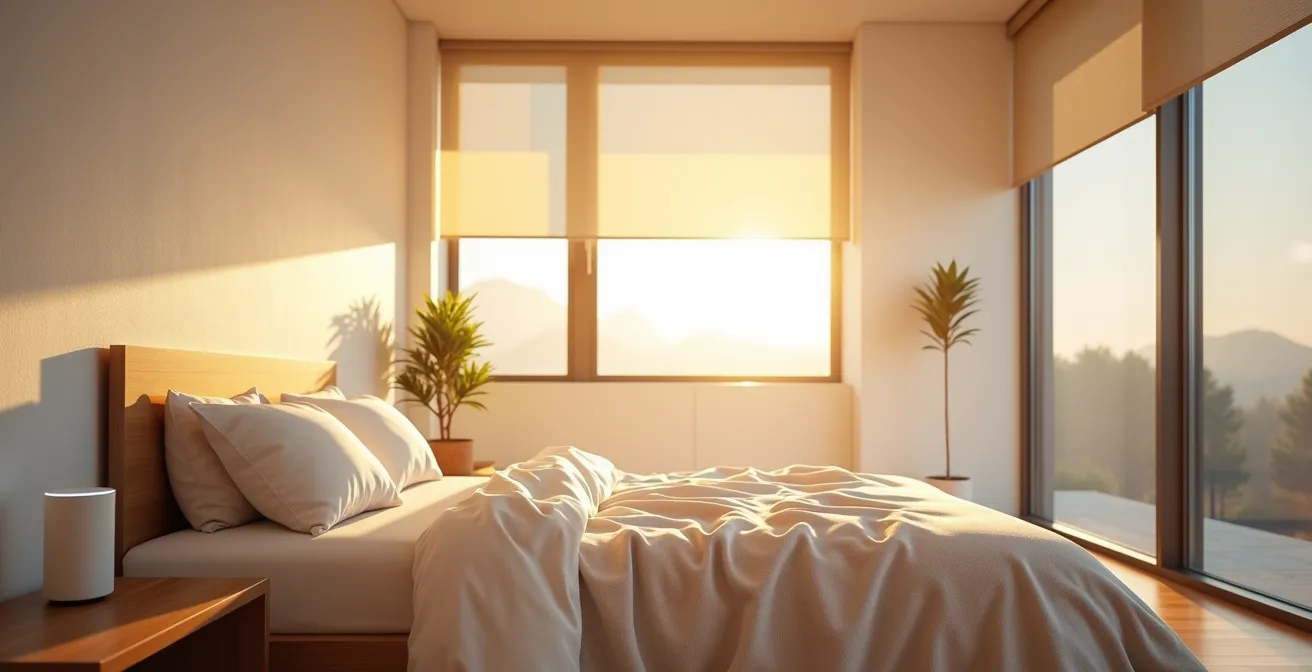
A truly smart morning routine isn’t about convenience; it’s a health optimization system designed to align your environment with your biology.
- Focus on invisible, sensor-driven automations (for air quality, light) that work for you, not the other way around.
- Build a resilient and secure system with local control to avoid cloud dependency and protect your data.
Recommendation: Start with one high-impact automation that targets a biological trigger—like circadian lighting or air quality—before trying to connect everything at once.
For the busy professional or biohacker, the morning is a battlefield of decisions. From the moment the alarm rings, a cascade of choices begins, draining precious mental energy before the day has even properly started. The common promise of the smart home is to alleviate this, often summarized by a simple voice command that turns on the lights and starts the coffee maker. It’s a nice trick, but it barely scratches the surface of what’s possible. This approach treats your home like a collection of remote controls, offering mere convenience.
But what if your home could be more than just convenient? What if it could function as an integrated ecosystem, proactively preparing an optimal environment for your body and mind? This requires a shift in thinking: from collecting gadgets to architecting a system. It’s about creating a space that understands your biological needs—from the quality of the air you breathe to the spectrum of light that wakes you—and automates a response. This is the concept of biological alignment, where technology serves not just to save time, but to enhance health and focus.
This guide moves beyond basic IFTTT recipes. We will explore how to build a resilient, secure, and health-centric morning automation system. We’ll cover how to manage your home’s air quality to fight fatigue, secure your network from prying devices, choose the right control interfaces to reduce cognitive load, and configure your lighting to work with your body’s natural clock. It’s time to stop telling your home what to do and start letting it anticipate what you need.
This article provides a comprehensive roadmap to architecting a truly intelligent morning. Below is a summary of the key areas we will explore to transform your home from a collection of devices into a personalized wellness ecosystem.
Summary: Architecting a Health-Focused Smart Morning
- Why Ignoring Indoor Air Quality Is Causing Your Chronic Fatigue?
- How to Create a VLAN for Your Smart Fridge so It Can’t Spy on Your PC?
- Voice Control vs App Control: Which Is More Practical for Kitchen Appliances?
- The “Cloud Dependency” Risk: What Happens When Your Smart Device Maker Goes Bust?
- How to Extend the Battery Life of Your Smart Sensors from 6 Months to 2 Years?
- When to Automate Household Chores: The ROI of Smart Home Investments
- How to Organize Your Kitchen to Make Eating Fruit Easier Than Eating Chips?
- How to Configure Smart Lighting to Boost Energy in the Morning and Sleep at Night?
Why Ignoring Indoor Air Quality Is Causing Your Chronic Fatigue?
You wake up feeling groggy and unrested, even after a full eight hours of sleep. The culprit might not be your mattress or your schedule, but the very air you’re breathing. During the night, in a sealed bedroom, human respiration steadily increases carbon dioxide (CO2) levels. Once concentrations exceed 1000 parts per million (ppm), cognitive function begins to decline, and feelings of drowsiness and fatigue set in. Many people start their day with this invisible environmental handicap. Automating indoor air quality (IAQ) isn’t a luxury; it’s a fundamental step toward a more energetic morning.
The solution is a proactive system that monitors and manages your air. A small CO2 sensor is the brain of this operation, tracking levels while you sleep. When a preset threshold is crossed, it triggers a response: activating a smart fan, an ERV (Energy Recovery Ventilator), or even a smart window opener to introduce fresh air. This simple automation ensures you wake up in an environment with optimal oxygen levels, clearing brain fog before it even forms. Beyond CO2, Volatile Organic Compounds (VOCs) from cleaning products or furniture can also degrade air quality. An air purifier scheduled to run a high-power purge cycle just before you wake up can eliminate these pollutants, creating a truly clean slate for your lungs and mind.
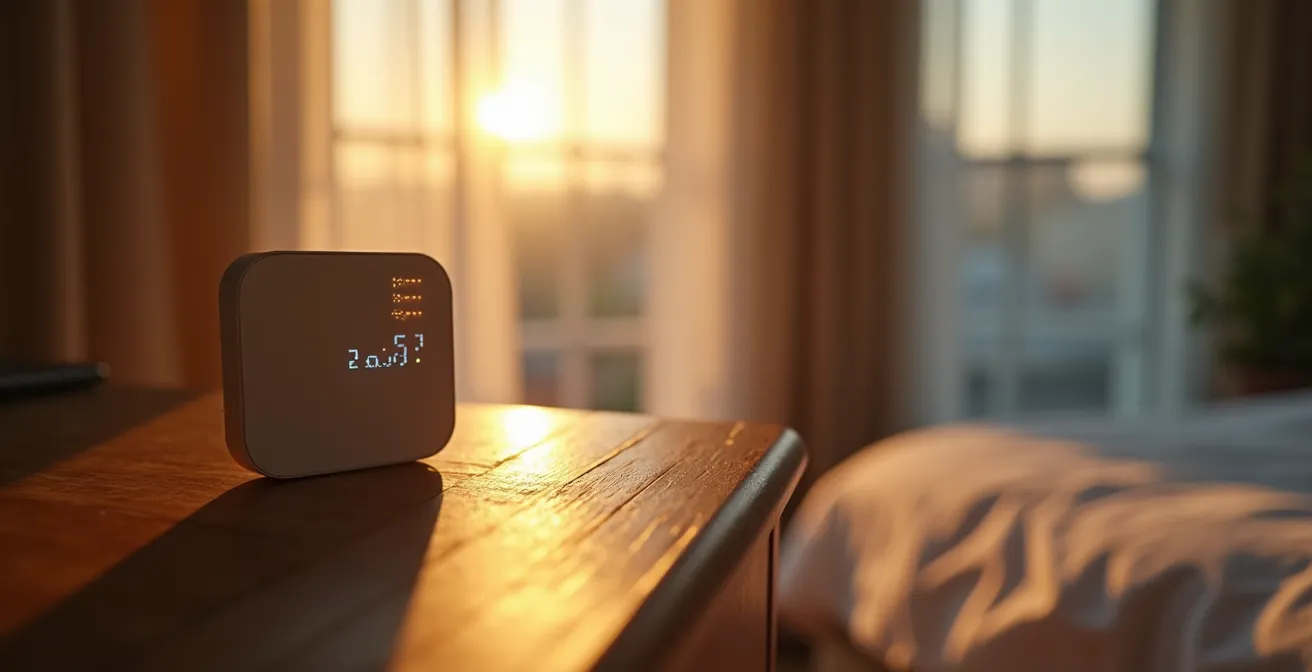
This setup transforms your bedroom from a passive space into an active wellness zone. By automating air exchange based on real-time data, you are directly addressing a primary cause of morning fatigue. It’s a perfect example of technology working in the background to produce a tangible biological benefit, ensuring you start your day with maximum mental clarity.
Your Action Plan: Morning Air Quality Automation Setup
- Install a CO2 sensor in your bedroom and set an alert threshold at 1000 ppm to detect stale air.
- Connect a smart fan or window opener to the CO2 sensor’s triggers using a platform like IFTTT or Home Assistant.
- Program your air purifier to run a high-power “purge” mode for 15-20 minutes before your scheduled wake-up time.
- Place a VOC sensor in the kitchen or living area to trigger ventilation if levels spike, for example, during cooking.
- Configure an essential oil diffuser to activate only after the air has been purified, ensuring you’re not just masking poor air quality.
How to Create a VLAN for Your Smart Fridge so It Can’t Spy on Your PC?
As you build your smart ecosystem, you’re also creating dozens of new entry points into your home network. That smart coffee maker or light bulb, often built with minimal security, can become a trojan horse for an attacker. If a hacker compromises a simple IoT device on a “flat” network—where every device can see every other device—they can potentially pivot to access sensitive files on your PC or spy on your activity. This is where the concept of digital fortification becomes crucial. The solution is network segmentation using a Virtual LAN (VLAN).
Think of a VLAN as creating a digital guest house on your property. Your critical devices (PCs, phones, network storage) live in the main house with full access. Your IoT devices (smart plugs, fridge, sensors) are restricted to the guest house. They can access the internet to do their job, but they are blocked from ever knocking on the door of the main house. This containment is a non-negotiable security posture for any serious smart home. In a real-world scenario, a 2023 security audit revealed how a vulnerability in a smart plug allowed attackers to pivot to a PC’s files; a VLAN would have stopped this attack in its tracks.
Setting up a VLAN might sound intimidating, but modern routers have made it increasingly accessible. The goal is to isolate untrusted devices without sacrificing their functionality. This foundational security step ensures that as you add more smart devices to enhance your life, you aren’t inadvertently opening the door to digital threats.
| Method | Difficulty | Security Level | Required Equipment |
|---|---|---|---|
| Guest Network | Easy | Good | Modern Router |
| Router VLAN | Medium | Better | VLAN-capable Router |
| pfSense/Ubiquiti | Advanced | Best | Dedicated Hardware |
Voice Control vs App Control: Which Is More Practical for Kitchen Appliances?
The smart home is often marketed through two main interfaces: the futuristic appeal of voice commands (“Alexa, make me a coffee”) and the granular control of a smartphone app. Both have their place, but for a truly optimized morning routine, they represent a kind of failure. The ultimate goal of automation is to eliminate the need for conscious commands altogether. The most practical interface is the one you never have to think about: the invisible, sensor-driven trigger.
Every time you have to pull out your phone to tap a button or remember a specific voice command, you expend a small amount of mental energy. This is cognitive load. While minor, it accumulates, defeating the purpose of reducing morning friction. The real magic happens when the environment anticipates your needs. A pressure mat by your bed that starts the coffee maker, a motion sensor in the hallway that slowly brightens the lights, or a humidity sensor in the bathroom that activates the ventilation fan—these are examples of frictionless design. The system responds to your presence and the environment’s state, not to your explicit commands.
This isn’t just a theoretical preference; it’s what users find most effective. In fact, recent consumer research shows that 43% of Americans consider automated sensors superior to both voice and app control for their morning routines. By focusing on sensor-based automation, you move from actively managing your home to having a home that manages itself for you. This frees up your mind to focus on what truly matters: starting your day with intention and clarity.
The “Cloud Dependency” Risk: What Happens When Your Smart Device Maker Goes Bust?
Many Wi-Fi-based smart devices are wonderfully easy to set up, but they hide a significant vulnerability: cloud dependency. These devices rely on their manufacturer’s servers to function. If that company decides to discontinue a product, gets acquired, or simply goes out of business, your expensive smart gadget can become an inert piece of plastic overnight. This is the “cloud dependency” risk, and it turns your smart home investment into a gamble on a company’s long-term survival. A truly resilient system must prioritize local control.
The alternative is to build your ecosystem around devices that use open, local protocols like Zigbee, Z-Wave, or the new Matter/Thread standard. These devices communicate directly with a local hub in your home (such as Home Assistant, Hubitat, or OpenHAB), not with a distant server. This creates a self-sufficient network. Your automations will run instantly and reliably, even if your internet connection goes down or the manufacturer disappears. This architecture provides speed, privacy (your data stays in your home), and, most importantly, long-term resilience.
Future-proofing your smart home means making deliberate choices at the time of purchase. To build a system that will last, you must prioritize local control and interoperability. Here are the key principles for creating a resilient smart home:
- Choose devices that support local protocols: Zigbee, Z-Wave, and Thread/Matter are the gold standards.
- Invest in a dedicated local hub like Home Assistant, Hubitat, or OpenHAB to act as the brain of your system.
- Be wary of “Wi-Fi-only” devices that require a specific manufacturer’s app and have no local control option.
- Periodically test your core automations with the internet disconnected to confirm they are truly running locally.
- Always maintain a backup of your automation rules and hub configuration.
This approach ensures your smart home remains smart for years to come, independent of corporate whims.
How to Extend the Battery Life of Your Smart Sensors from 6 Months to 2 Years?
A sprawling network of smart sensors is the nervous system of an automated home, but it comes with a major annoyance: changing batteries. If you find yourself replacing batteries every few months, the problem isn’t the batteries themselves—it’s your network architecture. The single biggest drain on a sensor’s battery is its radio. Wi-Fi, while fast, is incredibly power-hungry and ill-suited for small, battery-operated devices that only need to send tiny packets of data intermittently.
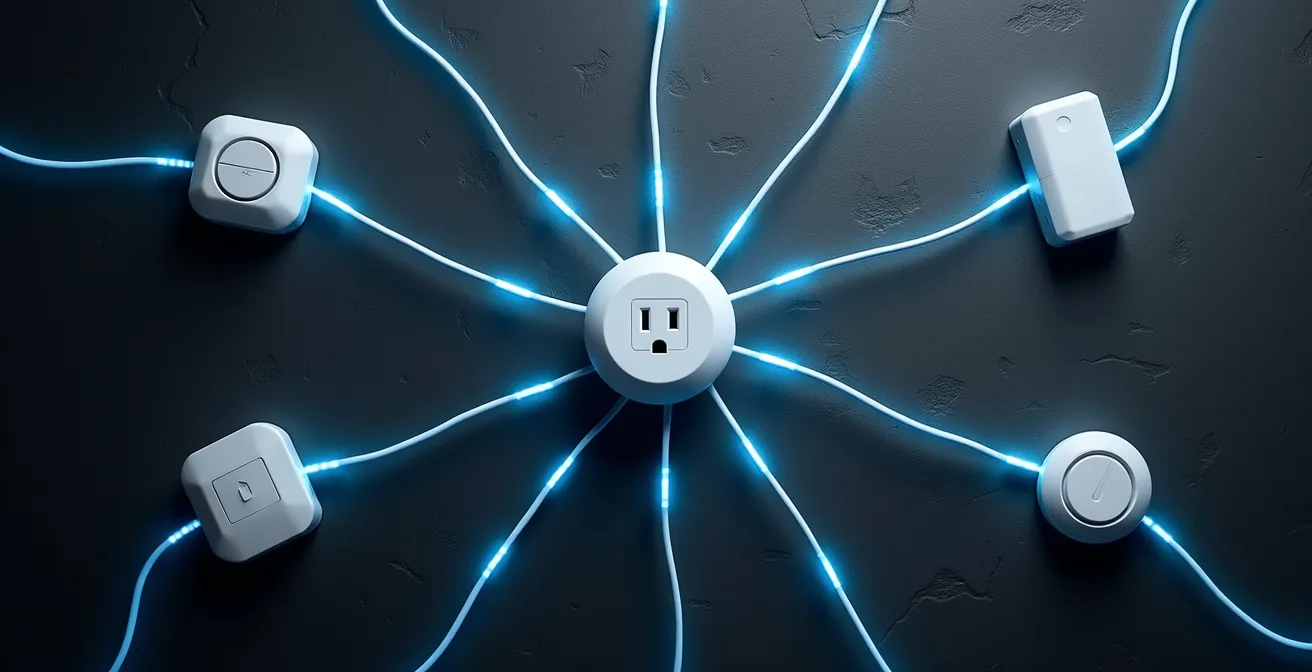
The key to multi-year battery life lies in using low-power mesh protocols like Zigbee and Z-Wave. Unlike Wi-Fi, where every device must connect directly to the router, mesh networks allow devices to relay messages through each other. This means a sensor far from the hub can send its signal via a nearby smart plug or light bulb, using a fraction of the power required for a direct Wi-Fi connection. The result is a more robust, self-healing network and dramatically extended battery life for your sensors, often stretching from a mere 6 months to 2 years or more.
While the network protocol is the primary factor, your choice of battery also plays a role, especially in different environments. For sensors placed in cold areas like a garage or mailbox, lithium batteries are far superior to alkaline, as they maintain performance in low temperatures. While they have a higher upfront cost, their extended lifespan often makes them more economical in the long run.
| Battery Type | Average Life (Low-drain IoT) | Cold Performance | Cost per Year |
|---|---|---|---|
| Alkaline | 6-8 months | Poor | $12 |
| Lithium (Energizer Ultimate) | 18-24 months | Excellent | $8 |
| NiMH Rechargeable | 4-6 months | Fair | $2 |
When to Automate Household Chores: The ROI of Smart Home Investments
What is the true return on investment (ROI) of automating your morning? It’s easy to calculate the time saved by a robot vacuum, but the most profound benefit is less tangible: the reduction of decision fatigue. Every small, repetitive choice you make—adjusting the thermostat, opening the blinds, remembering to take a supplement—depletes your finite willpower. Automating these micro-decisions frees up mental bandwidth for high-value tasks, creativity, and deep work. This is the “Cognitive ROI” of a well-designed smart home.
To decide what to automate first, you can use a simple “Annoyance Index” framework. For each task in your morning routine, rate it on a scale of 1-10 for how annoying it is. Then, multiply that by its frequency. Tasks with the highest score—often things like fumbling with blackout blinds or waiting for the coffee to brew—are your prime candidates for automation. They are the ones causing the most cognitive friction, and automating them will yield the highest immediate return in mental clarity.
The impact of this approach is significant, especially when it comes to health and consistency. Automating a task removes the possibility of forgetting it, which is a powerful tool for habit formation.
Case Study: Cognitive Load Reduction Through Morning Automation
A year-long study on executive function and automation found that participants using morning routine automation reduced their decision fatigue by an average of 40%. One executive, who previously struggled with medication adherence, automated their pill dispenser, lighting, and coffee prep. The system provided a visual light cue and an audible reminder until the medication was dispensed. The result was a 100% medication compliance rate, demonstrating a powerful ROI in health and consistency, a benefit far more valuable than a few saved minutes.
How to Organize Your Kitchen to Make Eating Fruit Easier Than Eating Chips?
The principles of automation can extend beyond convenience and into the realm of behavioral design, actively nudging you toward healthier choices. Your kitchen environment dictates your dietary habits. If grabbing a bag of chips is easier than peeling an orange, friction wins, and you’ll choose the chips. The goal is to use technology to invert this dynamic, making the healthy choice the path of least resistance. This is about organizing your environment for “choice architecture” that favors your long-term goals.
Start by making healthy food impossible to ignore. Place a fruit bowl in a prominent, high-traffic area. Then, use smart technology to draw attention to it. A smart LED strip installed under the cabinet above the bowl can be programmed to emit a gentle, pulsing, natural-hued light for the first hour of your morning. This visual cue acts as a silent, powerful reminder. In contrast, you can use smart plugs to disable “snack-making” appliances like the microwave or toaster during certain hours, adding friction to less-desirable choices.
This isn’t just theory; it’s a proven strategy for high performers. Behavioral science research demonstrates that 92% of high performers have structured morning habits, and that automating the visibility of healthy food can increase fruit consumption by as much as 65%. By adding an NFC tag to the fruit bowl, you can even make tracking effortless—a simple tap of your phone logs your healthy choice, reinforcing the habit loop. This is the pinnacle of smart automation: not just doing things for you, but helping you become who you want to be.
Key Takeaways
- Prioritize biological triggers: Automate your environment’s air quality and lighting to align with your body’s natural rhythms.
- Build for resilience and security: Use local control protocols (Zigbee, Z-Wave, Matter) and VLANs to create a fast, private, and future-proof system.
- The true ROI is cognitive: The greatest benefit of automation is the reduction of decision fatigue, which frees up mental energy for high-value tasks.
How to Configure Smart Lighting to Boost Energy in the Morning and Sleep at Night?
Light is the most powerful external signal for regulating your body’s internal clock, or circadian rhythm. For millennia, humanity rose with the bright, blue-hued light of the sun and wound down with the warm, dim glow of fire. Modern life, with its static indoor lighting, has disrupted this natural cycle, contributing to everything from poor sleep to morning grogginess. Smart lighting offers a powerful tool to reclaim this rhythm, transforming your lights from simple illumination to a dynamic wellness system.
A circadian lighting automation gradually changes the color temperature and intensity of your lights throughout the day. The morning sequence is key: instead of a single, jarring blast of light, the system simulates a natural sunrise. It begins with a very dim, warm light (around 2200K), gradually increasing in brightness and shifting toward a cool, blue-white daylight spectrum (6500K) over 20-30 minutes. This process gently suppresses the production of melatonin (the sleep hormone) and signals to your body that it’s time to be alert and energetic. As James Ridgway demonstrated with his Home Assistant setup, implementing zonal lighting—dim red in the bathroom, brighter at the vanity, and full daylight in the kitchen—can create a progressive light path that reduces eye strain and boosts alertness.
In the evening, the process reverses. The lights dim and shift back to a warm, amber glow, mimicking a sunset and encouraging melatonin production to prepare you for a restful sleep. This automated cycle aligns your indoor environment with the natural world, providing a constant, effortless signal to your body. It is one of the single most impactful automations you can implement for your overall well-being.
| Time | Lux Level | Color Temperature | Purpose |
|---|---|---|---|
| 6:00 AM | 100 lux | 2200K | Gentle wake initiation |
| 6:20 AM | 400 lux | 4000K | Transition phase |
| 6:30 AM | 800 lux | 6500K | Full wake/melatonin suppression |
| 8:00 PM | 50 lux | 2000K | Evening wind-down |
By shifting your focus from convenience to biological alignment, security, and resilience, you can transform your home. You’re no longer just controlling devices; you are conducting an orchestra of environmental inputs designed to help you feel and perform your best. Start today by choosing one area—air quality, lighting, or security—and build your first truly intelligent automation.